
e-AWB. International Air Transport Association






 WhatsApp
Electronic Air Waybill (e-AWB) IATA: International Air Transport
The International Air Transport Association (IATA) is the largest global association related to air cargo and passenger transport. It is made up of 290 airlines from 120 countries, representing 82% of the total air traffic.
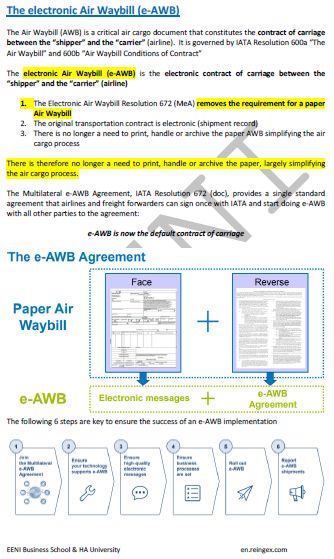
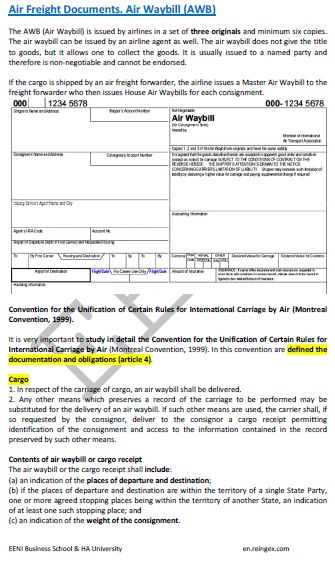
The Air Waybill (AWB) is an air cargo document that constitutes the contract of carriage between the sender and carrier (airline).

- Introduction to International Air Transport Association (IATA)
- History of IATA
- IATA Air Cargo Programs
- Electronic Air Waybill (e-AWB). Electronic Air Waybill Resolution
- E-Freight program. Interactive Cargo
- Unit Load Devices (ULD)
- IATA Dangerous Goods Regulations (DGR)
- Single African Air Transport Market (SAATM)
Sample - International Air Transport Association (IATA). e-AWB.

The Subject “International Air Transport Association (IATA). e-AWB.” is included within the curriculum of the following academic programs at EENI Global Business School:
Courses: Air transport, Multimodal Transport, Transport and Logistics in Africa.
Certificate in International Transport
Masters: International Transport, Transport and Logistics in Africa.


Languages: 
 Asociación de Transporte Aéreo Internacional (IATA)
 Association du transport aérien international (IATA)
  Associação Internacional de Transporte Aéreo (IATA).
International Air Transport Association (IATA). e-AWB.
- The resolution on IATA Air Waybill (e-AWB) eliminates the requirement for an AWB on paper
- E-AWB is now the default transportation contract for international air cargo transport
- In September 2018, air cargo industry processed more than 2.3 million air waybills (AWB)
- 76% of the AWBs are generated in Europe, Asia-Pacific and North Asia
- The global penetration of the e-AWB is currently estimated at 56%
The Unit Load Devices, mainly containers, allow a fast and economic handling for Air Transport cargo. The International Air Transport Association (IATA) developed the technical specifications for this type of unit load devices.
- The International Air Transport Association (IATA) also developed the Dangerous Goods Regulations for Safe Transportation
- IATA has developed several programs to reduce the costs in the Air Transport value chain
The Air Cargo Programs of the International Air Transport Association (IATA) are:
- Dangerous Goods (HAZMAT)
- Live animals
- StB Cargo
- Digital Cargo (e-Cargo)
- Cargo security
- Cargo operations
- Cargo iQ
- Pharmaceutical and health products
- Unit Load Devices
- Perishables
- Freight agency program
- Customs and Trade Facilitation
- Cargo Sustainability
- Air mail
- Future Air Cargo Executive (FACE)
The Airlines transport more than 52 million metric tons of products per year, representing more than 35% of world trade in value, but less than 1% of world trade in volume.

The International Air Transport Association (IATA) was founded in Havana (Cuba) in 1945. IATA is the successor to International Air Traffic Association founded in The Hague in 1919.
In 1944, IATA introduced the Chicago Convention.
The member countries of the Single African Air Transport Market (SAATM) are Benin, Cape Verde, Republic of the Congo, Ivory Coast, Egypt, Ethiopia, Kenya, Nigeria, Rwanda, South Africa and Zimbabwe.
The BIC Code (International Identification Codes of Container Owners) is accepted by the International Air Transport Association (IATA):
Trade Facilitation - Trade Facilitation Agreement - Kyoto Convention (Containers) - Convention Harmonization of Frontier Controls of Goods.
(c) EENI Global Business School (1995-2025)
Top of this page
