
India-Canada Economic Agreement


India-Canada Exhaustive Economic Partnership Agreement
- Introduction to the Comprehensive Economic Partnership Agreement (EPA) between India and Canada
- International Trade between India and Canada
- Foreign Trade Liberalization in goods and services
- Indian foreign direct investment in Canada
- Canadian investments in India (Bharat)

The Subject “India-Canada Economic Partnership Agreement” belongs to the following Online Programs taught by EENI Global Business School:
Masters: International Business, Foreign Trade.

Bhagavad Gita Courses: Karma Yoga, Bhakti Yoga, Jnana Yoga, Dhyana Yoga, Realization of the Gita
Doctorate: American Business, World Trade.

Course: Hinduism and Business.
Languages:  or
or  India-Canadá
  Inde-Canada
  India.


India-Canada Exhaustive Economic Partnership Agreement.
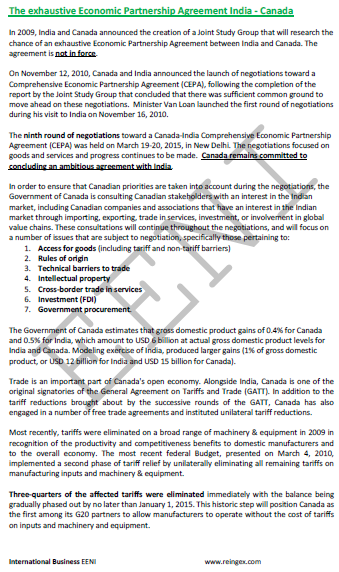
In 2009, India and Canada announced the creation of a Joint Study Group that will research the chance of an Exhaustive Economic Partnership Agreement between India and Canada.
- The agreement is not in force
- The Canadian Government estimates that the GDP gains 0.4% for Canada and 0.5% for India, which amount to USD 6 billion at actual GDP levels for India and Canada
- The modeling exercise of India, produced larger gains (1% of the GDP, or USD 12 billion for India and USD 15 billion for Canada)
Sample - India-Canada Exhaustive Economic Partnership Agreement (FTA)
Foreign Trade Canada-India.
- Exported products from Canada to India augmented at an compound annual rate of 24% over this period, while the imports from India grew by 13%. India was the 16th trading partner (products) of Canada
- Canada was the 30th trading partner of India
- The leading Indian export sectors to Canada are chemical products (25.2% of the total exports to Canada), textiles and wearing apparel (24.9%), other manufacturing products as well as machinery and equipment
- Over the past nine years, the Foreign Trade in services between Canada and India tripled to reach USD 693 million
- Top services of Canada from India are travel services
Canada belongs to the North American Economic Area (Western Civilization) and India to the Hindu Economic Area.
Indian Trade Agreements: Sri Lanka, Thailand, Indonesia, Singapore, ASEAN, South Korea, EU, New Zealand, Africa-India, Mauritius, Australia, Gulf Cooperation Council (GCC), Southern African Customs Union (SACU)...
(c) EENI Global Business School (1995-2024)
We do not use cookies
Top of this page