
Trade in Services (GATS Doha) Market Access






 WhatsApp
General Agreement on Trade in Services (GATS) liberalization
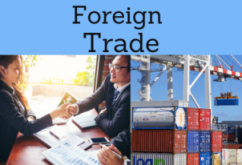
Since 1995 the General Agreement on Trade in Services (GATS) is in force. The main objective is to liberalize Foreign Trade in Services (exports and imports) transparently to increase world trade.
The General Agreement on Trade in Services (GATS) covers all exportable services (WTO identifies twelve basic sectors and 160 sub-sectors): tourism, business services, information technology, transport, finance, education, architecture, telecommunications, healthcare, insurance, construction, engineering, distribution, environmental, cultural, and sporting services.
- Introduction to the General Agreement on Trade in Services (GATS)
- Transparency and liberalization in International Trade in Services
- Modes of supply of Trade in Services
- Most-favoured-nation
- Market access and national treatment
- List of commitments
- Agreement, Annexes, and Schedules of GATS
- Case Study: Trade in Services under the United States-Colombia FTA and EU-Mexico Agreement
- General Agreement on Trade in Services (GATS) and national regulations
- Doha Development
- Other questions related to the General Agreement on Trade in Services (GATS)
- Analysis of World Trade in Services
- Introduction to the Services Directive of the European Single Market
Trade in Services. General Agreement on Trade in Services
(GATS)
The educational aims of the Subject “Trade in Services. General Agreement on Trade in Services (GATS)” are the following:
- To understand the importance of GATS
- To understand the key concepts related to Trade in Services: modes of supply, most-favoured-nation, liberalization, market access, and lists of commitments
- To analyze the global market in services

The Subject “General Agreement on Trade in Services (GATS)” is included within the curriculum of the following academic programs at EENI Global Business School:
Masters: Foreign Trade, International Business.


Postgraduate Certificate in International Trade.
Languages:  (or
(or  Comercio de Servicios
  Commerce de services
  Comércio de serviços).
- Subject Credits “Trade in Services”: 2

Area of Knowledge: Foreign Trade. Intellectual Property Rights (TRIPS).
International Trade in Services. General Agreement on Trade in Services (GATS)
The General Agreement on Trade in Services (GATS) seeks to promote Trade in Services of Developing Countries.
- In developed economies, services sector accounts for an average of 70% of GDP, while in Developing Countries is often below 50%
- The United States is the largest global services exporter (14% of the total), followed by the UK (6%), Germany (6%), China, France, India, Japan, and Spain
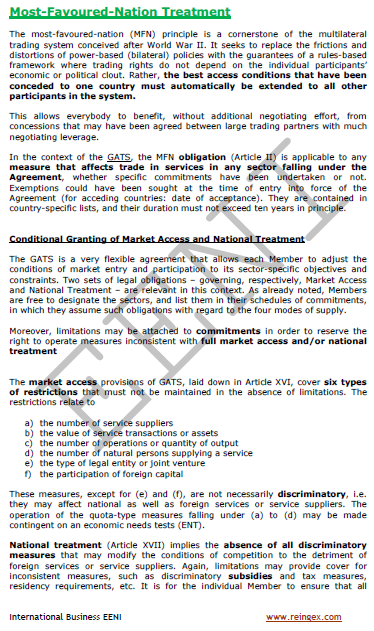
Under the General Agreement on Trade in Services (GATS) the most- favoured-nation may apply.
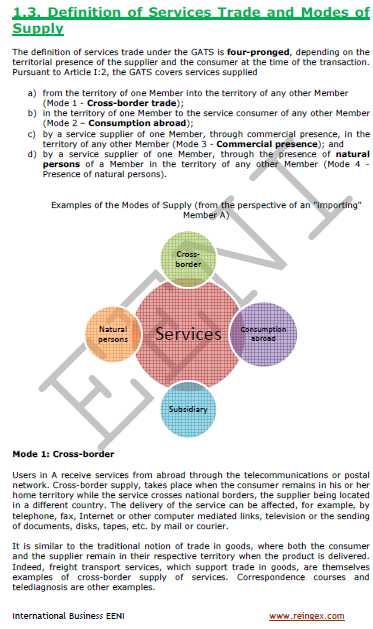
The General Agreement on Trade in Services (GATS) identifies four modes in the form of providing a service abroad:
- Cross-border trade
- Consumption abroad
- Commercial presence
- Presence of natural persons
The General Agreement on Trade in Services (GATS) is perfectly compatible with Regional Trade Agreements (RTAs): Free Trade Agreements (FTAs) and Economic Partnership Agreements (ACE).
In many FTAs usually, we will find chapters on Trade in Services and labour markets so that we will analyze the US-Colombia FTA and EU-Mexico FTA.
(c) EENI Global Business School (1995-2025)
Top of this page
