
Central American Foreign Trade and Economy







 WhatsApp
Foreign Trade, Central America. Guatemala, Belize, Honduras, El Salvador

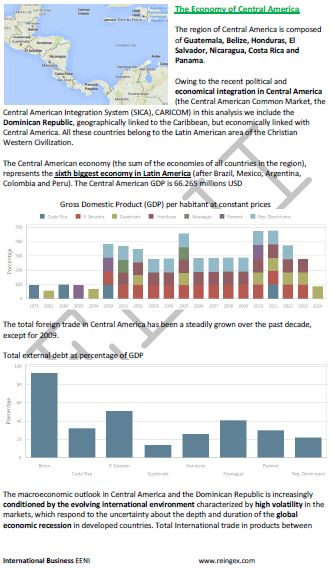
The Central American region consists of Guatemala, Belize, Honduras, El Salvador, Nicaragua, Costa Rica, and Panama.
Owing to the recent political and economic integration in Central America (Central American Common Market, Central American Integration System, CARICOM) in this analysis we include the Dominican Republic, geographically linked to the Caribbean, but economically linked to Central America.

- Introduction to the Central American region: Guatemala, Belize, Honduras, El Salvador, Nicaragua, Costa Rica, and Panama
- Central American Economy
- International Trade of Central America
- Investment in Central America
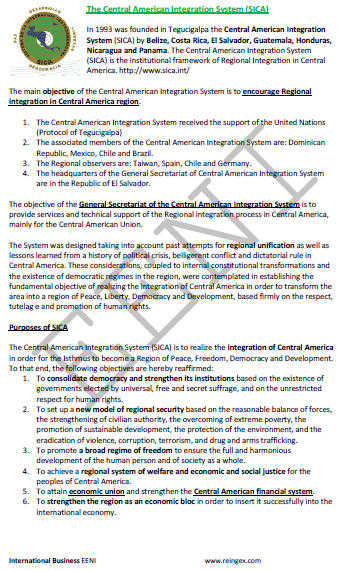
- Central American Integration System
Central American Economy

The educational aims of the Subject “Economy of Central America” are the following:
- To learn about economic profile of the Central American Countries
- To analyze the strengths and trends of the Central American Economy
- To evaluate the Central American Foreign Trade of Foreign Direct Investment flows
- To understand the role of the Central American Integration System in the region

The Subject “Central American Economy and International Trade” is included within the curriculum of the following academic programs at EENI Global Business School:
Masters: International Business, Foreign Trade.


Languages:  or
or  America Central
  Amerique Centrale
  América Central.
- Subject Credits “Central American Economy”: 1

All these countries belong to the Hispanic American Economic Area.
The Central American Economy (the sum of the economies of all Countries in the region), represents the sixth largest economy in Hispanic America (after Brazil, Mexico, Argentina, Colombia, and Peru).
Foreign Trade in Goods between the Central America markets and the rest of the world has been developed positively in recent years.
- The United States is the main trading partner of Central America (31.6% of total exports of the region and the 33.4% of total imports)
- Four export products (coffee, bananas, integrated circuits, and parts for machines) stand for 25.1% of total exports to the world
- The largest importer from Central American countries are the United States and South America (Brazil, Colombia, Venezuela, and Argentina)
- The Central American Common Market (MCCA) is the second-largest trading partner of the Central American Countries (29.4% of exports and 12.7% of imports)
The Central American region has a population of 41,739
million people, and an area of 522,760 km² (1% of the World area).
Country (Capital) - Population (in million)
- Belize (Belmopan): 322,100
- Costa Rica (San Jose): 4,579
- El Salvador (San Salvador): 7,185,218
- Guatemala (Guatemala City): 14,027
- Honduras (Tegucigalpa): 7,466
- Nicaragua (Managua) 5,743
- Panama (Panama City): 3,454
(c) EENI Global Business School (1995-2025)
Top of this page
