
Incoterms

Incoterms® 2020. DAT DAP FOB CIF EXW FCA CIP
- Introduction to the Incoterms® 2020
- What are the Incoterms® 2020?
- Key changes to the Incoterms® 2020
- The Review of the Incoterms® FCA (Free Carrier)
- The change from DAT (Delivered at Terminal) to DPU (Delivered at Place Unloaded)
- Different levels of insurance coverage under CIF and CIP
- Associated costs for each Incoterm (article A9 / B9)
- Analysis of the Incoterms® 2020
- Incoterms® 2020 and international transport
- Incoterms® 2020 for sea and inland waterway transport: FAS (Free Alongside Ship) - FOB (Free On Board) - CFR (Cost and Freight) - CIF (Cost, Insurance & Freight)
- Incoterms® 2020 for any mode of transport: EXW (Ex Works) - FCA (Free Carrier) - CPT (Carriage Paid To) - CIP (Carriage and Insurance Paid to) - DAP (Delivered At Place) - DPU (Delivered at Place Unloaded) - DDP (Delivered Duty Paid)
- How are they used?
- Criteria for selection of the Incoterms® 2020
The objectives of the subject “Incoterms® 2020” are the following:
- To understand the responsibilities of the exporter and the importer under the Incoterms® 2020
- To know how the Incoterms® 2020 are used in International Trade transactions
- To know how to calculate the export prices based on the Incoterm
- To identify the risk, cost, and formalities according to the selected Incoterm
Incoterms® 2020:

The Subject “Incoterms” belongs to the following Online Programs taught by EENI Global Business School:
Courses: Export Assistant, Foreign Trade Management.
Masters: International Business, Foreign Trade and Global Marketing, International Transport, Transport in Africa.

Doctorate: Global Logistics, World Trade.

Languages:  or
or  Incoterms
  Incoterms
  Incoterms الإنكوتيرمز.
Credits of the Subject “Incoterms® 2020”: 2
 .
.
Sample of the Subject: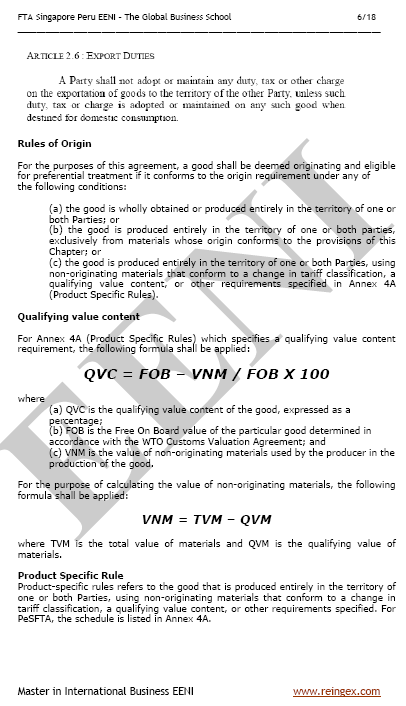
Incoterms® 2020
The Incoterms® 2020 are a set of international rules for the interpretation of the international trade terms set forth by the International Chamber of Commerce.
On January 1, 2020 the International Chamber of Commerce (ICC) presented the new Incoterms® 2020.
- The word Incoterm is an abbreviation of International Commercial Terms
- The chosen Incoterm is a term of the contract of sale
- The Incoterms® 2020 are not terms of the contracts of carriage or delivery
- In International Trade transactions, one of the aspects to be defined is the place of delivery of the products. This place, previously agreed between the importer and the exporter, must be stated in the international sales contract
The Incoterms® 2020 facilitates foreign trade (imports and exports) by clearly defining:
- Place of delivery
- Who is the responsible for the transport to the place of delivery
- Who assumes the risks and the place at which the risk passes from the exporter to the importer
- Whom customs clears products for Import/Export
- Moreover, many more significant obligations
The Incoterms® 2020 also establish a body of international rules for the interpretation of the most commonly used international trade terms.
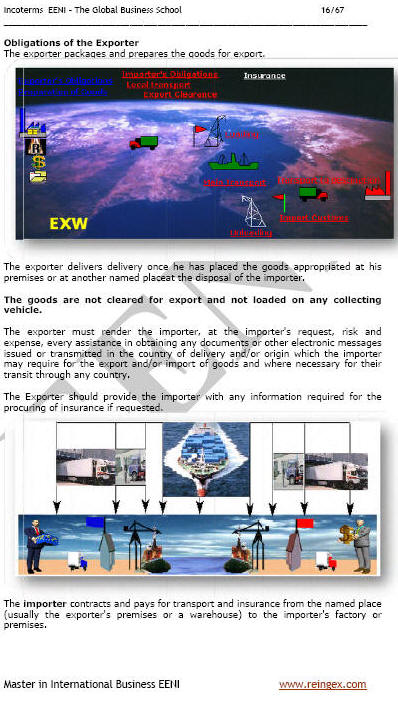
Defining the obligations.
The Incoterms® 2020 enable the contracting parties to set out clearly and concisely extent of their respective duties, and above all, the moment when the costs and risks are transferred from the exporter to the importer.
In the Incoterms® 2020, the parties define the point to which the exporter is the responsible for the products and what are the expenses relating to his obligations, which will, therefore, should be included in the price offered by the exporter.
The Incoterms® 2020 cover various modes of transport of products, clearly defining in the international contract of sale the respective obligations of the exporter and the importer in each case.
Incoterms® 2020
In the Incoterms® 2020, all the associated costs with a given Incoterm are indicated in article A9 / B9.
The Incoterms® 2020 recognise that the transport can be carried out by the exporter or the importer, and not necessarily by a carrier.
Review of the Incoterm® 2020 FCA (Free Carrier)
Free Carrier (FCA) has been revised for those situations in which products are exported through FCA to be transported by sea, and the exporter or the importer (or their banks) requests a bill of lading with an on-board notation.
The importer will instruct the carrier to issue an on-board bill of lading to the exporter once the goods have been loaded on board, and that the exporter will then present the document (bill of lading) to the importer (usually through banks).
Change from DAT (Delivered in Terminal) to DPU (Delivered at Place Unloaded)
DPU (Delivered at Place Unloaded) is not a new Incoterm, but a name change from the old DAT (Delivered at Terminal), changing from Terminal to Place Unloaded.
Different levels of insurance coverage in CIF and CIP
Incoterms 2020 provide different levels of insurance coverage in CIF (Cost, Insurance and Freight) and CIP (Carriage and Insurance Paid To). The most used coverage is provided by the "Institute Cargo Clauses (C)"
It is essential that anyone using the Incoterms® 2020 buy the ICC guide (40 Euros in e-Book format, 50 Euros on paper) available in 29 languages.
"Incoterms" and the "Incoterms® 2020 logo" are trademarks of the International Chamber of Commerce (ICC).
FIATA Transport Documents and Incoterms® 2020
FIATA Transport Documents and Incoterms.
- Negotiable Combined Transport Bill of Lading (FBL)
- FIATA FWB. Recommended Incoterms® 2020: CFR, CIF, DDP
- e-Bill of Lading
- FIATA FCR. Incoterm: EXW (Ex Works)
- FIATA FCT. Recommended Incoterm: CIF (Cost, Insurance and Freight)
- Warehouse Receipt
Incoterms® 2010 (Obsolete)
While Incoterms® 2020 is the most current version of the trade terms, Incoterms® 2010 is still current today for those who use them.
- The number of the Incoterms® 2010 rules was reduced from 13 to 11
- New Incoterms® 2010:
- DAT (Delivered At Terminal)
- DAP (Delivered At Place)
- Incoterms® 2010 for sea and inland waterway transport:
- FAS (Free Alongside Ship, named port of shipment)
- FOB (Free On Board, named port of shipment)
- CFR (Cost and Freight, named port of destination)
- CIF (Cost, Insurance & Freight, named port of destination)
- Incoterms® 2010 for any mode of transport (Multimodal/unimodal):
- EXW (Ex Works, named place of delivery)
- FCA (Free Carrier, named place of delivery)
- CPT (Carriage Paid To, named place of destination)
- CIP (Carriage and Insurance Paid to, named place of destination)
- DAT (Delivered At Terminal, named terminal at port or place of destination)
- DAP (Delivered At Place, named place of destination)
- DDP (Delivered Duty Paid, named place of destination)
- Incoterms® 2010 Delivered at Origin:
- EXW (Ex Works)
- FCA (Free Carrier)
- FAS (Free Alongside Ship)
- FOB (Free On Board)
- CPT (Carriage Paid To)
- CFR (Cost and Freight)
- CIP (Carriage and Insurance Paid to)
- CIF (Cost, Insurance & Freight)
- Incoterms® 2010 Delivered at Destination:
- DAT (Delivered At Terminal)
- DAP (Delivered At Place)
- DDP (Delivered Duty Paid)
- Replaced Incoterms® 2010: DAF, DES, DEQ, and DDU.
INCOTERM DAP (DELIVERED AT PLACE, named place of destination).
- May be used for all transport mode
- The exporter delivers when the products, once unloaded from the arriving means of carriage, are made available to the importer at a named terminal at the named port or place of destination
- “Terminal” includes quays, warehouses, container yard or road, Rail or Air terminal
- Both parties should agree on the terminal and if possible a point within the terminal at which point the risks will transfer from the exporter to the buyer of the product
- If it is intended that the exporter be to bear all the costs and responsibilities from the terminal to another point, DAP or DDP may apply
INCOTERM DAT (DELIVERED AT TERMINAL, named terminal at port or place of destination)
- May be used for all transport modes
- The exporter delivers the products when are placed at the disposal of the importer on the arriving means of transport ready for unloading at the named place of destination
- The parties are advised to specify, as clearly as possible, the point within the agreed place of destination because risks transfer at this point from exporter to importer
- If the exporter is the responsible for clearing the products or paying duties, consideration should be given to using the DDP term
Website: International Chamber of Commerce.
Incoterms® 2000 (Not in force).
- EXW EX WORKS (... named place)
- FCA FREE CARRIER (... named place)
- FAS FREE ALONGSIDE SHIP (... named port of shipment)
- FOB FREE ON BOARD (... named port of shipment)
- CFR COST and FREIGHT (... named port of destination)
- CIF COST, INSURANCE and FREIGHT (... named port of destination)
- CPT CARRIAGE PAID TO (... named place of destination)
- CIP CARRIAGE and INSURANCE PAID TO (... named place of destination)
- DAF DELIVERED AT FRONTIER (... named place)
- DES DELIVERED EX SHIP (... named port of destination)
- DEQ DELIVERED EX QUAY (... named port of destination)
- DDU DELIVERED DUTY UNPAID (... named place of destination)
- DDP DELIVERED DUTY PAID (... named place of destination)