Forum for East Asia-Latin America Cooperation


Trade Relations Latin America-Asia (FEALAC) China, Brazil
- Introduction to the Forum for East Asia-Latin America Cooperation
- Purposes and organization of the FEALAC
- Economic Profile of the Member States of the Forum Latin America-East Asia
- Economic and trade relations between Latin America and Asia
- Manila Action Plan
The objectives of the subject “Forum for East Asia-Latin America Cooperation (FEALAC)” are the following:
- To understand the goals and organization of the FEALAC
- To analyze the economic relations between East Asia and Latin America (Iberian America)
- To understand the concept of the FEALAC as the “missing link” between East Asia and Latin America (Iberian America)

The Subject “Forum for East Asia-Latin America Cooperation (FEALAC)” belongs to the following Online Programs taught by EENI Global Business School:
Masters: International Business, Foreign Trade.


Languages:  or
or  Foro de Cooperación América Latina-Asia (FOCALAE)
  Forum de coopération Amérique latine-Asie (FEALAC)
  Fórum de Cooperação América Latina-Ásia do Leste (FOCALAL).
The Forum for East Asia-Latin America Cooperation is the “missing link” between East Asia and Latin America.
Sample - Forum for East Asia-Latin America Cooperation (FEALAC):
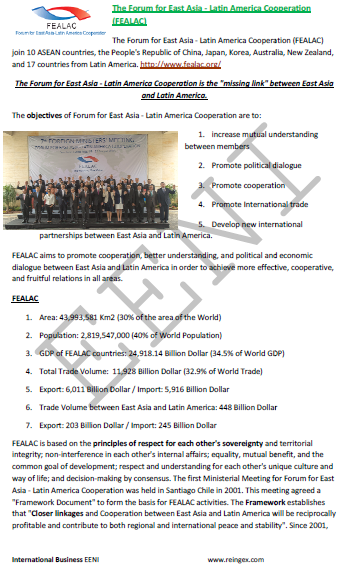
The Forum for East Asia-Latin America Cooperation (FEALAC) joins ten ASEAN countries, China, Japan, Korea, Australia, New Zealand, and seventeen Latin American Countries.
The thirty-three countries participating in the Forum for East Asia-Latin America Cooperation (FEALAC) are:
- East Asia: Australia, Brunei, Cambodia, Indonesia, Japan, Laos, Malaysia, Myanmar, New Zealand, Philippines, Singapore, South Korea, Thailand, and Vietnam
- Latin America: Argentina, Bolivia, Brazil, Chile, Colombia, Costa Rica, Cuba, Dominican Republic, Ecuador, El Salvador, Guatemala, Mexico, Nicaragua, Panama, Paraguay, Peru, Uruguay, and Venezuela
The objectives of the Forum for East Asia-Latin America Cooperation are to:
- Increase the mutual understanding between the members
- Promote the political dialogue
- Promote the economic cooperation
- Promote the international trade
- Develop a new international partnerships between East Asia and Latin America (Iberian America)
The first Ministerial Meeting of the Forum for East Asia-Latin America Cooperation (FEALAC) took place in Santiago de Chile in 2001. This meeting agreed a “Framework Document” to form the basis for the FEALAC activities.
The Framework establishes that “Closer linkages and cooperation between East Asia and Latin America will be reciprocally profitable and contribute to both regional and international peace and stability.”
Driven by the rise of China and India, the old linkages are being revived and new ones forged between Latin America and Asia. International Trade between East Asia and Latin America has augmented.
From the religious point of view, the Forum consists of thirty-three countries:
- Christians: Australia, New Zealand, the Philippines, Argentina, Bolivia, Colombia, Brazil, Chile, Costa Rica, Cuba, the Dominican Republic, Ecuador, El Salvador, Guatemala, Mexico, Nicaragua, Panama, Paraguay, Peru, Uruguay, and Venezuela
- Muslim: Brunei, Indonesia, and Malaysia
- Buddhists: Cambodia, Japan, Laos, Myanmar, Singapore, Thailand, Vietnam, and South Korea
- China. Multi-religious country (Buddhism, Confucianism, and Taoism)
The Forum for East Asia-Latin America Cooperation (FEALAC) is an inter-civilization agreement between the.
(c) EENI Global Business School (1995-2024)
We do not use cookies
Top of this page