
European Union-Central America Agreement


Central America (Costa Rica, Guatemala, Honduras)-EU Free Trade Agreement
- Introduction to the Association Agreement between Central America and the EU
- EU-Central America Agreement
- Trade Relations between the EU and the Central American Countries

The Subject “Association Agreement between Central America and the EU” belongs to the following Online Programs taught by EENI Global Business School:
Masters: International Business, Foreign Trade.



Languages:  or
or  UE-America Cenral
  UE-Amérique centrale
  UE.
UE.
 EU Students
Sample - EU-Central America Association Agreement (FTA)
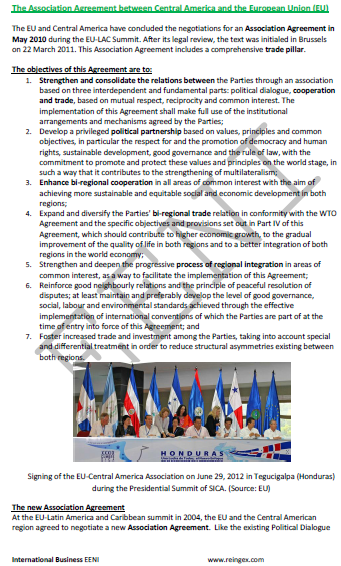
The European Union and the Central American Countries (Costa Rica, El Salvador, Guatemala, Honduras, Nicaragua, and Panama) finished the negotiations for an Association Agreement in 2010.
Foreign Trade EU-Central America.
- The main EU imports from Central America are office and telecommunication equipment (54%) and agricultural export products (35% in 2010)
- The main exports from the EU to Central America are machinery and Transport equipment (49%) and chemicals products (12%)
The Central American Countries belong to the Latin American Economic Area and the EU to the European Economic Area of Western Civilization.
(c) EENI Global Business School (1995-2024)
We do not use cookies
Top of this page