Business in Malaysia, Malaysian Economy



 WhatsApp
Malaysian International Trade, Logistics, Kuala Lumpur, Malaysia. Tan Sri Mokhtar
Malaysia is a world leader in Islamic finance, with a financial system that combines Sharia principles with the demands of a global marketplace. Islam, the majority religion in Malaysia, prohibits riba (interest), gharar (excessive uncertainty), and investments in haram activities (such as alcohol, gambling, or excessive speculation). Since the 1980s, Malaysia has developed a financial ecosystem that complies with these principles, attracting both Muslims and non-Muslims.
From a nation dependent on agriculture and primary commodities in the 60´s, Malaysia has become an export-driven economy speed up by high-technology, knowledge-based and capital-intensive industries.

- Introduction to Malaysia (Southeast Asia)
- Malaysian Political System
- Ethnic Groups
- Bahasa Malayu
- Government policies
- Malaysian Economy
- Infrastructure in Malaysia
- Key sectors in Malaysia:
- Metal
- Electrical and electronics
- Engineering
- Food industry
- Machinery and equipment
- Medical devices
- Petrochemical and polymer
- Pharmaceuticals
- Rubber
- Malaysian Textiles
- Wood
- Doing Business in Kuala Lumpur
- Malaysian International Trade
- Transport and Logistics
- Business Environment
- Case Study:
- Tan Sri Mokhtar
- Islamic Finance in Malaysia
- Telekom Malaysia Berhad
- PADINI
- Access to the Malaysian Market
- Business Plan for Malaysia
Economic Corridors related to Malaysia
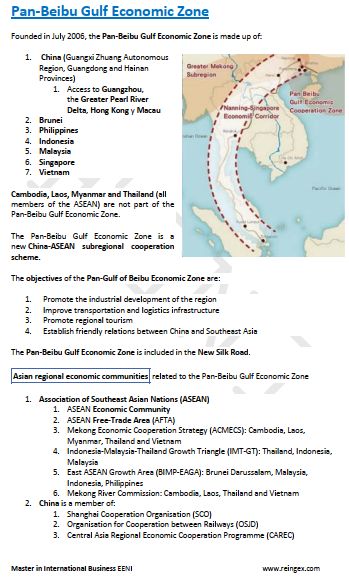
- Nanning-Singapore Logistics Corridor
- Access to the East-West Economic Corridor (Myanmar-Thailand-Laos-Vietnam)
International Trade and Business in Malaysia: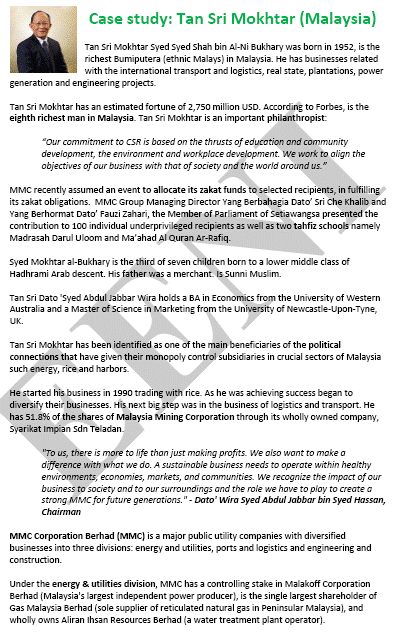

The educational aims of the Subject “Foreign Trade, Logistics and Business in Malaysia” are:
- To analyze the Malaysian Economy, Logistics and Global Trade
- To conduct research on business opportunities in Malaysia
- To explore the Malaysian trade relations with the student's country
- To learn about Malaysian Trade Agreements
- To examine the profile of Malaysian companies
- To develop a business plan for the Malaysian Market

The Subject “Foreign Trade, Logistics and Business in Malaysia” is included within the curriculum of the following academic programs at EENI Global Business School:

Masters: International Business, Foreign Trade.
Masters adapted to  Malaysian Students.
Languages:  or
or  Malasia
  Malaisie.
- Subject Credits “Doing Business in Malaysia”: 2

International Trade, Logistics and Business in Malaysia.
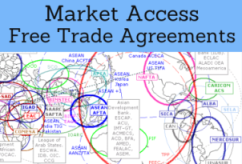
Malaysian Market Access and Trade Agreements.
- ASEAN
- ASEAN Free Trade Area
- ASEAN Economic Community
- East ASEAN Growth Area
- Indonesia-Malaysia-Thailand Growth Triangle
- Cambodia has trade agreements (as a member of ASEAN) with China, India, the EU, Japan, Korea, Russia, the United States, Australia-New Zealand Agreement
- APEC
- Indian-Ocean Rim Association
- Agreement for Trans-Pacific Partnership
- Islamic Trade Preferential System
- Islamic Centre for Development of Trade
- Regional Comprehensive Economic Association
- Global System of Trade Preferences
- European Union-Malaysia Partnership and Cooperation Agreement (negotiation)
- India-Malaysia Comprehensive Economic Cooperation Agreement
- Japan-Malaysia Agreement
- New Zealand-Malaysia Agreement
- Malaysia-Australia Agreement
- Pakistan-Malaysia Agreement
- Malaysia has Trade Agreements with Chile and Jordan
Sample: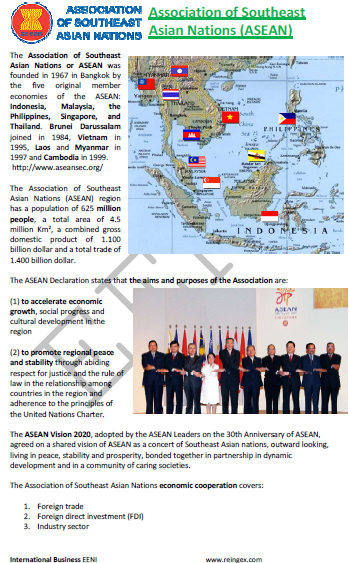
- World Trade Organization (WTO)
- Agreement on Trade in Services (GATS)
- Agreement on Sanitary Measures
- Agreement on Technical Barriers to Trade
- Agreement on Preshipment Inspection
- Agreement on Safeguards
- Trade Facilitation Agreement
- World Customs Organization (WCO)
- Kyoto Convention
- BIC
- Chicago Convention (ICAO)
- International Maritime Organization (IMO)
- Convention for Safe Containers
- Istanbul Convention
- Customs Convention on Containers - not a member
- Islamic Development Bank
- Organization of Islamic Cooperation (OIC)
- Asia-Middle East Dialogue
- Economic Commission for Asia (ESCAP)
- Asian Development Bank
- Boao Forum for Asia
- East Asia-Latin America Cooperation
- Asia Cooperation Dialogue
- Colombo Plan
- Africa-Asia Partnership
- United Nations
- World Bank
- World Trade Organization (WTO)
- International Monetary Fund
- Pacific Economic Cooperation Council
- 50% of the population of Malaysia are Malays. 22% are Chinese
- The Malays originated from the Malayo-Polynesian Ethnic Group
- The official language in Malaysia is Bahasa Malayu.
- English is recognized
- Malaysian Population: 30.8 million people
- Malaysian Area: 329,847 km²
- Malaysian Capital: Kuala Lumpur
- Administrative capital of Malaysia: Putrajaya
- Borders of Malaysia: Thailand, Indonesia, Singapore, and Brunei
- Type of Government: Federal Parliamentary constitutional monarchy
- Yang di-Pertuan of Malaysia: Agong Abdul Halim
- Malaysian independence: 1957 (United Kingdom)
Main religion in Malaysia: Sunni Islam (18 million, 63% of the population).
- Islam is the official religion of Malaysia
- Unifying factors among Malays is Islam
- In Malaysia, nearly all Malays are Muslims
- Fiqh (Islamic Jurisprudence): Shafi
- Other religions: Buddhism (20%), Christianity (9%), Hinduism (6%), Confucianism, and Taoism
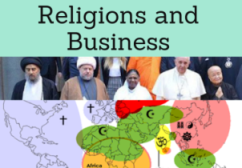
Religions and Global Business -
Religious diversity
Malaysia belongs to Islamic Civilization.
Kuala Lumpur, and its surrounding urban areas, form the most industrialized region in Malaysia.
- The Greater Kuala Lumpur, also known as the Klang Valley, is an urban agglomeration of 7.2 million people
- Kuala Lumpur is poised to become the Global Islamic Financing hub with an increasing the number of financial institutions providing Islamic Financing
Malaysian Economy.
- The Malaysian Government policies that sustain a business environment with opportunities for growth and profits have made Malaysia an attractive manufacturing and International Trade base in the region
- The private sector in Malaysia has become partners with the public sector in achieving development objectives
- The Malaysian Industrial Development Authority is the first point of contact for foreign investors who intend to set up projects in manufacturing and services sectors in Malaysia
- Malaysia offers the world it's Multimedia Super-corridor which brings together a legislative framework and a next-generation of telecommunications infrastructure in eco-friendly surroundings to create the best environment for multimedia industries development
- Malaysian currency: The Ringgit (RM) (MYR)
Telekom Malaysia Berhad is the leading integrated information and communications group in Malaysia, offers an exhaustive range of communication services and solutions (broadband, data, and fixed-line). As a market leader in broadband and fixed-line enterprises, Telekom Malaysia Berhad is driven to deliver value to its stakeholders in a highly competitive environment.
Padini began as a back-end operation in the apparel industry, manufacturing, International Trade, and supplying garments in Malaysia for retailers and Distributors. It has entered the new millennium as a major force in Malaysia's multibillion textile and garment industry, a Brand leader implicated in distribution and retail of its fashion brands through 190 freestanding stores, franchise, and consignment counters.
Port Klang is on the west coast of Peninsular Malaysia, 40 kilometers from the capital Kuala Lumpur. Its proximity to the greater Klang Valley - The commercial and industrial hub of Malaysia as well as Malaysia's most populous region guarantees that the port plays a key position in the economic development of Malaysia.
(c) EENI Global Business School (1995-2025)
Top of this page
