
Subjects (Course: Foreign Trade Assistant)





 WhatsApp
Detailed content of the Subjects of the Course “Foreign Trade Assistant”
Online Course “Foreign Trade Assistant” offered by EENI Global Business School.
Download the syllabus (PDF) of the Professional Course.
ECTS = European Credit Transfer and Accumulation System

 Enrol / Request for Information
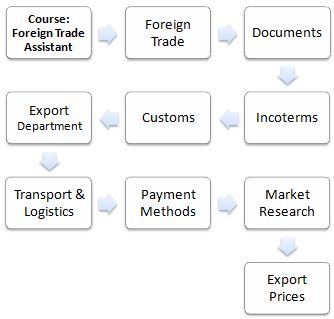
The Subjects of the Course “Foreign Trade Assistant”
Introduction to Foreign Trade (1 ECTS)
- Introduction to Foreign Trade
- Advantages of exporting
- Resources Needed for exporting
- Starting the Export Activity
- Export Process
- Problems deriving from Non-Internationalization
- Tariffs and Quotas
The educational aims of the Subject “Introduction to Foreign Trade” are the following:
- To understand the nature of exporting and difficulties that may arise
- To learn about import and export transactions, difficulties with them and how to overcome these challenges
- To analyze the advantages of exporting and risks of not exporting
This will be achieved by:
- Examining the fundamental questions related to the export process
- Analyzing the challenges to overcome in an export transaction
- Detailing the steps necessary to beginning the export process
Foreign Trade Documents (1 ECTS).
- The role of documents in Foreign Trade Back Office and International Trade
- International transport documents
- Commercial documents (proforma, invoice, packing list...)
- Origin documents
- Other Foreign Trade Documents
The educational aims of the Subject “Foreign Trade Documents” are the following:
- To learn about function of the main documents used in imports and exports
- To know how to fill them out properly
- To know how to perform the check-list of Foreign Trade Documents
Incoterms® 2020 (2 ECTS)
- Introduction to Incoterms
- What are Incoterms® 2020?
- Key changes to Incoterms® 2020
- The Review of Incoterms® FCA (Free Carrier)
- The change from DAT (Delivered at Terminal) to DPU (Delivered at Place Unloaded)
- Different levels of insurance coverage under CIF and CIP
- Associated costs for each Incoterm (article A9 / B9)
- Analysis of Incoterms® 2020
- Incoterms® 2020 and international transport
- Incoterms® 2020 for sea and inland waterway transport: FAS (Free Alongside Ship) - FOB (Free On Board) - CFR (Cost and Freight) - CIF (Cost, Insurance & Freight)
- Incoterms® 2020 for any mode of transport: EXW (Ex Works) - FCA (Free Carrier) - CPT (Carriage Paid To) - CIP (Carriage and Insurance Paid to) - DAP (Delivered At Place) - DPU (Delivered at Place Unloaded) - DDP (Delivered Duty Paid)
- How are they used?
- Criteria for selection of Incoterms® 2020
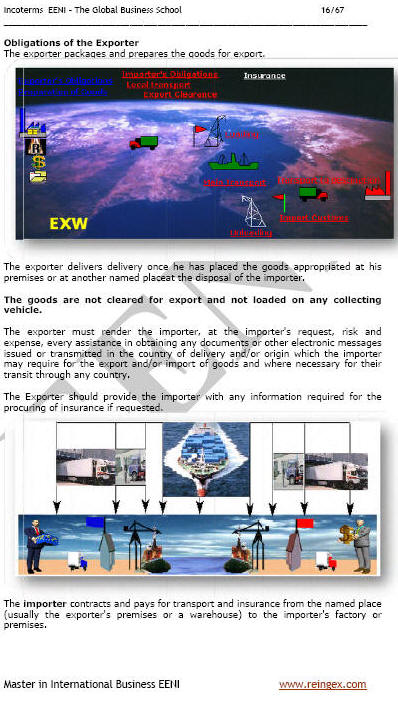
The educational aims of the Subject “Incoterms® 2020” are the following:
- To understand the importance of Incoterms® 2020 in Foreign Trade
- To know which Incoterms® 2020 are the most suitable for the different types of International Transport
- To know how to calculate export prices based on Incoterms® 2020
- The Risk, cost and necessary procedures according to the selected Incoterm
Customs. World Trade Organization (WTO) (4 ECTS).
- Customs in Foreign Trade
- Customs classification
- Customs regime
- The role of the customs agent
- Customs clearance
- Inspection of the products at customs
- Origin of products
- Tariffs and Quotas
- Trade Agreements
- Market Access database (EU)
- Trade Facilitation Agreement
- World Customs Organization (WCO)
- Kyoto Convention (Containers)
- Convention Harmonization of Frontier Controls of Goods
- Global System of Trade Preferences (GSTP)
- Harmonized System (HS)
- Rules of Origin
- Agreement on Rules of Origin of WTO
- Trade Facilitation
- Customs Procedures
- SAFE Package
- Kyoto Convention
Customs and the World Trade Organization (WTO).
- The World Trade Organization and Customs
- Rules for Customs Valuation of products
- Customs Valuation Methods:
- Transaction value
- Identical or similar goods
- Deductive or computed method
- Fall-back
- Rules of Origin
- Import licenses
- WTO Agreements on Technical Barriers to Trade (TBT), Sanitary and Phytosanitary Measures (MSF), and Pre-shipment Inspection
The educational aims of the Subject “Customs” are the following:
- To understand customs procedures in Foreign Trade, different commercial regimes and methods of product classification
- To learn about the fundamental concepts related to customs: customs clearance, customs valuation, non-tariff barriers and obstacles, pre-shipment inspection, origin of goods, Harmonized System, customs processes...
- To learn about process of importing a product and customs regimes
- To understand the functions of WCO and WTO related to customs
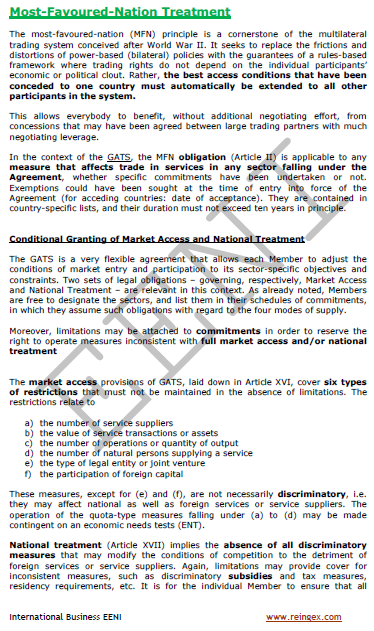
Export Department (1 ECTS).
- Introduction to the Export Department
- Set up and run of the export department
- Functions, goals, and organization of the export department
- Resources needed
- Director of International Business, export manager, and country area manager
- Foreign Trade Back Office
- Foreign Trade Assistant
- Secretary of the department of International Trade
- Case Study:
- Analysis of the differences between the Export Departments in Spain and Latin America (Iberian America)
- Sales areas assignment in international department
The educational aims of the Subject “Export Department” are the following:
- In this subject, student will learn how to set up and run an export department
- We will also discuss the functions and goals of the export department
This will be achieved by:
- Examining the characteristics of an export manager
- Outlining the most important functions of an export department
- Analyzing the goals of an export department and how to benchmark them
- Detailing how to best support the export department work
International Transport and Logistics (5 ECTS)
- Introduction to International Transport and Logistics
- International transport chain
- Authorized Economic Operator
- Selecting a mode of International Transport
- Costs and insurance of International Transport
- Transport Documents related to International Trade
- Export Packaging
Containers and international transport.
- Customs Convention on Containers
- International Convention for Safe Containers
- Convention Relating to Temporary Admission
International Federation of Freight Forwarders Associations (FIATA).
- Negotiable Combined Transport Bill of Lading (FBL)
- Electronic FIATA Bill of Lading
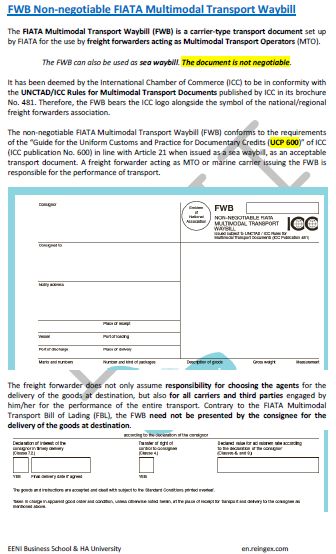
- FIATA Multimodal Waybill FWB
- Forwarders Certificate of Receipt (FIATA FCR)
- Forwarders Certificate of Transport (FCT)
- Warehouse Receipt
Sample: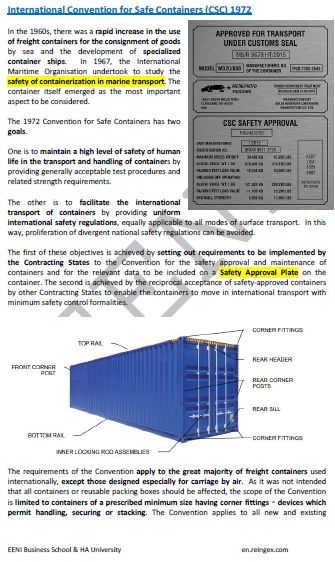
The educational aims of the Subject “Introduction to International Transport and Logistics” are:
- To have a global vision of logistics and international transport applied to International Trade
- To understand the functioning of global transport chain
- To learn about different techniques of export packaging and the importance of containers
- To understand the basic concepts related to documents, costs and insurance of International Transport
- To analyze the main FIATA documents
International Payment Methods. Documentary Credits (4 ECTS)
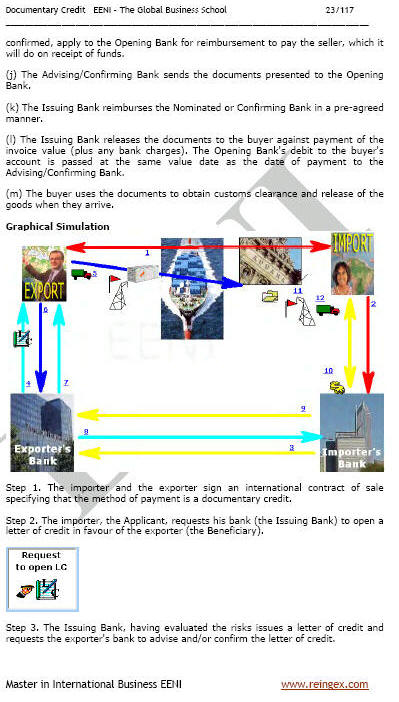
- Introduction to International Methods of Payment and the Letters of Credit
- Documentary Collections
- The importance of Documentary Credits in Foreign Trade
- Letter of credit
- Types, modalities and variants of Documentary Credits
- Analysis of the contents of a letter of credit
- Analysis of Documentary Credits
- UCP 600
- E-UCP
- United Nations Conventions related to the International Payment Methods
- United Nations Convention on Independent Guarantees and Stand-by Letters of Credit
- United Nations Convention on International Bills of Exchange and International Promissory Notes
- United Nations Convention on Transfer of Credits in International Trade
- UNCITRAL Model Law on International Credit Transfers
The educational aims of the Subject “Documentary Credits and International Payment Methods” are:
- To analyze the different Payment Methods used in International Trade
- To understand the fundamental role of Documentary Credits in International Trade as well as their operation and modalities
- To know how to manage a Foreign Trade operation through a documentary credit
Global Market Research (2 ECTS)
- Introduction to Global Market Research
- How to export?
- What to export?
- Where to export?
- Methods of conducting a global market research
- Quantitative analysis
- Qualitative methods
- Market profitability
- Sales potential in foreign markets
- PESTEL Analysis (Political, Economic, Social, Technological, Environmental, and Legal)
- Case Study: Market research using the market access tool (MADB) of the European Union
The main purpose of the Subject “Global Market Research” is to understand the key tools and concepts of Global Market Research and how best to apply them.
- To understand the importance of Global Market Research in Internationalization Strategies
- To know how to analyze an Global Market Research
- To learn how to use the PESTEL analysis (Political, Economic, Social, Technological, Environmental and Legal Factors)
This will be achieved by:
- Analyzing the goals of researching a new export market
- Outlining the features of qualitative and quantitative analysis
- Detailing the type of information that the student should obtain to assess the commercial viability of an export market
Export Prices Calculation (1 ECTS)
- Introduction to Global Pricing Policy
- Product life cycle and Global Pricing Policy
- Calculation of export prices
- International prices and Incoterms® 2020
- Analysis of competitor's prices
- International Pricing Strategies
- Pricing strategy when entering new export markets
- Pricing options available to the exporter
- E-Business and pricing policy
- Religion and export prices
- Case Study:
- Pricing Policy and Inflation
- Price of Traded Goods and Services in Asia
The main purpose of the Subject “Global Pricing Policy” is to understand the importance of an appropriate pricing strategy when entering new export markets.
- We are going to examine pricing options available to the exporter and outline the criteria to be used when establishing a pricing strategy
- We will also look at the criteria defined in pricing under Incoterms
This will be achieved by:
- Examining pricing options available to the exporter
- Outlining the criteria to be used when establishing a pricing strategy
- Analyzing the goals of a pricing policy
- Detailing how to arrive at an export price
- Introducing the criteria defined in pricing under Incoterms® 2020
 Curso Asistente de Comercio Exterior
 Cours : assistant de commerce international
  Curso: Assistente de Comércio Exterior.
(c) EENI Global Business School (1995-2025)
Top of this page
