
APEC Trade Agreements - Tariff Liberalization





 WhatsApp
APEC Agreements. Market Access Provisions. Trade barriers
APEC identifies the critical function that the Regional Trade Agreements can perform in the regional trade liberalization in the Asia-Pacific Region.
APEC was followed by the ASEAN Free Trade Agreement foundation in 1992. However, many Asian economies (Singapore, South Korea, Japan, and China) also have launched to pursue Trade Agreements. Singapore has finished thirteen Trade Agreements.
There also have been multilateral Trade Agreements initiatives in the Asia-Pacific region.
- Trade Agreements and Regional Trade Agreements (RTA) in APEC region
- Convergences and Divergences in Trade Agreements
- Market Access dispositions in APEC Region
- State of Integration in the Asia-Pacific Region: Tariff Liberalization
- Rules of Origin. Customs Procedures
- Sanitary and Phytosanitary Measures
- Technical Barriers to Trade
- International Trade in Services
- Investment in APEC markets
- Free Trade Area of the Asia-Pacific (FTAAP)

The Subject “APEC Trade Agreements” is included within the curriculum of the following academic programs at EENI Global Business School:

Master: International Business.

 or
or 


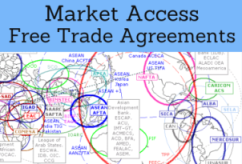
Trade Agreements (Asia-Pacific Economic Cooperation).
China has entered into a Trade Agreements with ASEAN, and the chapter on Foreign Trade in products of the ASEAN-Korea FTA entered into force in 2007.
The Agreement between Japan and ASEAN was signed on 2008.
ASEAN multilateral initiatives include a proposal for an ASEAN-India economic partnership and a recent decision to convert the long-standing bilateral trade cooperation between the ASEAN-Australia and New Zealand into a Trade Agreements.
Mains Trade Agreements:
1- Australia-New Zealand
2- Peru-Mexico
3- Australia-Papua New Guinea
4- ASEAN
5- US-Mexico-Canada Agreement
6- Canada-Chile Agreement
7- Chile-Mexico Agreement
8- Singapore-New Zealand Agreement
9- Singapore-Australia Agreement
10- Singapore-Japan Agreement
11- ASEAN-China
12- Australia-United States
13- Mexico-Japan Agreement
14- Chile-U.S. Agreement
15- US-Singapore Agreement
16- South Korea-Chile Agreement
17- China-Hong Kong, China
18- Japan-Malaysia
19- Japan-Thailand
20- Singapore-Korea Agreement
21- P4
22- Australia-Thailand
23- New Zealand-Thailand
24- US-Peru
25- Chile-China
26- Japan-the Philippines
27- Chile-Peru
28- Peru-Thailand
29- Chile-Japan
30- Korea-United States
Australia-Chile Agreement.
Other Trade Agreements: Singapore-Jordan, Singapore-Panama.

APEC Member Countries: Australia, Brunei, Canada, Chile, Hong Kong, Indonesia, Japan, Korea, Malaysia, Mexico, New Zealand, Papua New Guinea, Peru, Philippines, Russia, Singapore, Chinese Taipei (Taiwan), Thailand, United States, and Vietnam.
Sample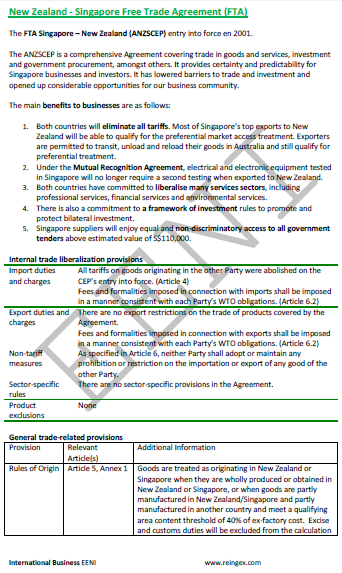
(c) EENI Global Business School (1995-2025)
Top of this page
