Singapore-Korea Agreement


Singapore-South Korea Free Trade Agreement
- Introduction to the South Korea-Singapore FTA
- Foreign Trade in Goods, Services, and Investment
- Benefits to the Singaporean and the South Korean Exporters
- Rules of Origin

The Subject “South Korea-Singapore Free Trade Agreement” belongs to the following Online Programs taught by EENI Global Business School:
Masters: International Business, Foreign Trade.

Courses: Taoism, Confucianism & Business, Buddhism and Business.
 or
or 

South Korea-Singapore Free Trade Agreement.
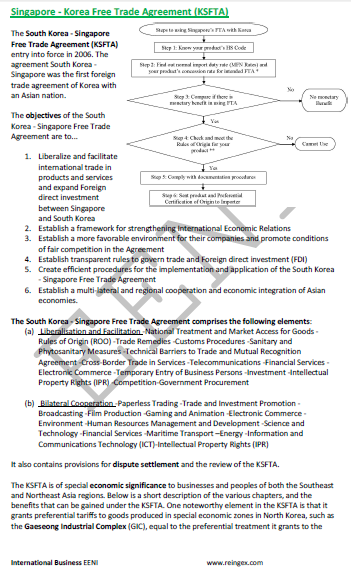
The South Korea-Singapore Free Trade Agreement (FTA) entry into force in 2006. The agreement between South Korea and Singapore was the first trade agreement of South Korea with an Asian nation.
The objectives of the South Korea-Singapore Free Trade Agreement are to:
- liberalize and facilitate the International trade in goods and services and expand the foreign direct investment between Singapore and South Korea
- Establish a framework for strengthening the International Economic Relations
- Establish a more favorable environment for their companies and Promote a fair competition conditions
- Set-up transparent rules to govern the trade and foreign direct investment
- Create an efficient procedures for the implementation and application of the South Korea-Singapore Agreement
- Establish a multilateral and regional cooperation and economic integration of the Asian economies
The South Korea-Singapore Free Trade Agreement covers:
- Liberalization and Trade Facilitation:
- National Treatment
- Market Access for export products
- Rules and certificate of origin
- Foreign trade remedies
- Customs Procedures
- Sanitary and Phytosanitary Measures
- Technical Barriers to Trade
- Cross-Border Trade in Services
- Telecommunications
- Financial Services
- E-Commerce
- Temporary entry for business persons
- Intellectual Property Rights
- Bilateral Cooperation between South Korea and Singapore:
- Paperless trade
- Trade and foreign direct investment promotion
- Broadcasting
- E-Commerce
- Environment
- Financial Services and
- Maritime Transport
Sample - Singapore-Korea FTA Agreement
Foreign Trade Korea-Singapore:
- 75% of the Singaporean Exports to South Korea benefit from an immediate tariff elimination (cost advantage)
- Total international trade South Korea-Singapore recorded a foreign trade extra amounting to 3.47 billion dollars before the Singapore-Korea Free Trade Agreement deal was concluded
The South Korea-Singapore Free Trade Agreement (FTA) operates within the Buddhist Civilization.
(c) EENI Global Business School (1995-2024)
We do not use cookies
Top of this page