Pacific Economic Cooperation Council (PECC)


Economic Integration in Asia-Pacific. Free-Trade Area (Asia). Food System
- Introduction to the Pacific Economic Cooperation Council (PECC)
- Task forces of the Pacific Economic Cooperation Council
- Trade and Investment in Services
- Pacific Food System
- State of the Region Report
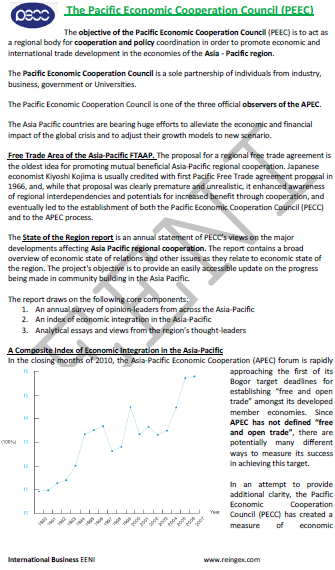
- Index of the economic integration in Asia-Pacific
- The Pacific Economic Cooperation Council and the Free-Trade Area of the Asia-Pacific

The Subject “Pacific Economic Cooperation Council (PEEC)” belongs to the following Online Programs taught by EENI Global Business School:
Masters: International Business, Foreign Trade.


Languages:  or
or  Consejo de Cooperación Económica del Pacífico
  Conseil de coopération économique du Pacifique (PEEC)
  Conselho de Cooperação Económica do Pacífico.
Pacific Economic Cooperation Council.
The objective of the Pacific Economic Cooperation Council (PEEC) is to act as a regional body for cooperation and policy coordination to promote the economic and international trade development in the economies in the Asia-Pacific region.
- The Pacific Economic Cooperation Council is a sole partnership of individuals from industry, business, Government, or Universities
- The Pacific Economic Cooperation Council is one of the three official observers of the APEC
- The Asia-Pacific countries are bearing enormous efforts to alleviate the economic and financial impact of the global crisis and to adjust their growth models to the new scenario
- Associate members: France (Pacific Territories)
- Institutional members: Pacific Trade and Development Conference and the Pacific Basic Economic Council
Pacific Economic Cooperation Council
The Pacific Economic Cooperation Council (PEEC) is an inter-civilization institution with members from:
- Western Civilization
- Latin American Economic Area: Chile, Colombia, Ecuador, Mexico, and Peru
- North American Economic Area: Canada and the U.S.
- Oceania area: Australia, New Zealand, and the Pacific Islands Forum
- Islamic Civilization: Brunei, Indonesia, Malaysia, and Singapore
- Sinic-Buddhist Civilization: China, Hong Kong, Korea, Mongolia, Taiwan, Thailand, and Vietnam
- Japanese civilization: Japan
- And the Philippines
(c) EENI Global Business School (1995-2024)
We do not use cookies
Top of this page