Emerging - Frontier Markets - BRICS
About Emerging and Frontier Markets. BRICS (Brazil, Russia, India, and China)
Masters: International Business, Foreign Trade.

The term “Emerging Countries” was first used in the eighties by the World Bank. It is a classification that allows grouping the markets that are no longer developing countries but not yet reached the status of a developed country. However, it is a definition too relative and can create confusion. There is no international consensus on which countries are emerging or not.
For considering a country as “emerging,” must fulfill the following conditions:
- Wealth of raw materials and resources
- Industrialization
- Growing number of young workers
- Political stability
- Strong Foreign direct investment (FDI) flows
- Strong growth of local consumers
- Political and economic influence on the countries of their economic area
As we can see, it is hard to achieve an exact definition of an emerging country. Russia, for example, lacks a high political stability and yet is regarded as BRICS. Egypt is an emerging market but has political instability since the Arab Spring.
The most important thing is that the vast majority of the emerging countries are not the “classical” Western Civilization Countries (except some cases like Argentina or Mexico of the Latin American economic area). From a religious point of view, we can also observe the increasing specific weight of Hinduism, the Sinic religions (Confucianism, Taoism), Buddhism, and Islam. In any case, everything points to a political and global economic reorganization.
Therefore, in the Master we have included those countries that are usually considered as emerging, but which also offer extensive business opportunities. For example, Venezuela is often seen as emerging or frontier market, but the political and economic situation makes it inadvisable to do business in Venezuela.
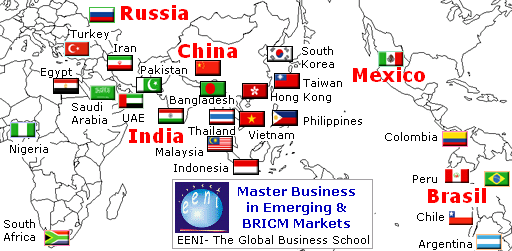
According to the World Bank, the five biggest Emerging Markets are China, India, Indonesia, Brazil, and Russia. Other countries that are also considered as emerging markets include Mexico, Argentina, South Africa, Poland, Turkey, and South Korea.
All the reputable economists agree that the future is in the Emerging Markets. These markets already are the largest source of the economic growth in the modern World, and their function is projected to increase considerably in the next twenty years.
Some of the largest emerging countries:
- China
- India
- Russia
- Brazil
- South Africa
South Africa officially became a member of the BRIC in 2010; BRIC was renamed to BRICS (S for South Africa).
Frontier Markets
Like the concept of an emerging country, the definition of a frontier market is relative; there is no global consensus on which markets they are frontier or not. The term frontier market (or proto-emerging, pre-emergent) was created in the nineties by the International Finance Corporation, to refer (from financial a point of view) to those countries with a strong and/or rapid economic growth that could turn into emerging economies.
A frontier market is also a country more developed than the less developed countries, but too small to be considered as an emerging market.
From a financial standpoint, are often the riskiest countries for investment (country risk, political change), however, the markets with more expectations. Some countries considered a frontier had previously been emerging. Currently, the MSCI Frontier Markets Index is usually the most used.
Other denominations related to the emerging countries:
- BRICS= BRIC + South Africa
- BRICM= BRIC + Mexico
- BRICA= BRIC + Cooperation Council for the Arab States of the Gulf Arab Countries - Saudi Arabia, Qatar, Kuwait, Bahrain, and the Emirates
- BRICET= BRIC + Eastern Europe and Turkey
- BRICK= BRIC + South Korea
- CIVETS (Colombia, Egypt, Indonesia, Vietnam, Turkey, and South Africa) (Source: Economist Intelligence Unit)
- Next Eleven (or N-11): Bangladesh, Egypt, Indonesia, Iran, Mexico, Nigeria, Pakistan, the Philippines, South Korea, Turkey, and Vietnam. Source: Goldman Sachs
- MIST: Mexico, Indonesia, South Korea, and Turkey
- Big Emerging Market (BEM): Brazil, China, Egypt, India, Indonesia, Mexico, the Philippines, Poland, Russia, South Africa, South Korea, and Turkey
- Standard and Poor's: Brazil, Chile, China, the Czech Republic, Egypt, Hungary, India, Indonesia, Malaysia, Mexico, Morocco, Peru, the Philippines, Poland, Russia, South Africa, Taiwan, Thailand, and Turkey
BBVA Research
- EAGLEs (Emerging and Growth-Leading Economies): Brazil, China, Egypt, India, Indonesia, Mexico, Russia, South Korea, Taiwan, and Turkey
- NEST: Argentina, Bangladesh, Colombia, Malaysia, Nigeria, Pakistan, Peru, the Philippines, Poland, South Africa, Thailand, and Vietnam
FTSE list.
- Advanced Emerging Markets: Brazil, the Czech Republic, Hungary, Malaysia, Mexico, Poland, South Africa, Taiwan, and Turkey
- Secondary Emerging Markets: Chile, China, Colombia, Egypt, India, Indonesia, Morocco, Pakistan, Peru, the Philippines, Russia, Thailand, and the United Arab Emirate
EENI Classification
- BRICM (Brazil, Russia, India, China, and Mexico)
- Asian Emerging Markets: Bangladesh, Indonesia, Iran, Malaysia, Pakistan, the Philippines, Singapore, South Korea, Taiwan, Thailand, and Vietnam
- Latin America Emerging Markets: Argentina, Colombia, Chile, and Peru
- Middle East Emerging Markets: Saudi Arabia, and the Emirates (UAE)
- European Emerging Markets: Croatia, Serbia, and Turkey
- African Emerging Markets: Egypt, Nigeria, and South Africa
| Country | BRIC | Next-11 | CIVETS | THE ECONOMIST | S&P | EAGLEs | Nest | BEM | FTS Advanced | FTS Secondary |
|---|---|---|---|---|---|---|---|---|---|---|
| Argentina |  |
|||||||||
| Bangladesh | |
|
||||||||
| Brazil | |
. | |
|
|
|
|
|||
| Chile | |
|
| |||||||
| China | |
. | |
|
|
|
| |||
| Colombia | |
|
|
| ||||||
| Croatia | ||||||||||
| Czech Republic | |
|
|
|||||||
| Egypt | |
|
|
|
|
|
| |||
| Hong Kong | |
|||||||||
| Hungary | |
|
|
|||||||
| India | |
. | |
|
|
|
| |||
| Indonesia | |
|
|
|
|
|
| |||
| Iran | |
|||||||||
| Malaysia | |
|
|
|
||||||
| Mexico | BRICM |
|
|
|
|
|
|
|||
| Morocco | |
|
| |||||||
| Nigeria | |
|
||||||||
| Pakistan | |
|
| |||||||
| Peru | |
|
|
| ||||||
| the Philippines | |
|
|
|
|
| ||||
| Poland | |
|
|
|
|
|||||
| Russia | |
. | |
|
|
|
| |||
| Saudi Arabia | |
|||||||||
| Singapore | |
|||||||||
| Serbia | ||||||||||
| South Africa | BRICS |
|
|
|
|
|
|
|||
| Sri Lanka | ||||||||||
| South Korea | BRICK |
|
|
|
|
|||||
| Taiwan | |
|
|
|
||||||
| Thailand | |
|
|
| ||||||
| Turkey | BRICET |
|
|
|
|
|
|
|
||
| United Arab Emirates | | |||||||||
| Vietnam | |
|
|


