
Foreign investment FDI

Foreign direct investment (FDI). Investments abroad. Expropriation risks
The Subject “Foreign Direct Investment” consists of three parts:
1- Foreign Direct Investment (FDI)
- Introduction to the foreign direct investment
- Global Investment Outlook
- The WTO and the foreign direct investment
- Agreement on Trade-Related Investment Measures (TRIM)
- The OECD and the foreign direct investment
- The EU policy on foreign direct investment
- The Multilateral Investment Guarantee Agency (MIGA)
- Index of Economic Freedom (Heritage)
- FDI and the developing countries
2- Conference on Trade and Development (UNCTAD) and foreign direct investment.
- Introduction to the UN Conference on Trade and Development (UNCTAD)
- Index of foreign direct investment
- Inward and outward Index. Methodology
- World Investment Report
- Establishing companies abroad: sales delegations, affiliated companies, branches, and joint ventures
- Optimizing the expropriation risks
- Corporate governance
- Investing in the developing countries
- Case Study: Reconstruction of an industry in the former Soviet Republics
The objectives of the subject “Foreign Direct Investment” are the following:
- To offer a global vision of the foreign direct investment
- To understand the role of the UN Conference on Trade and Development (UNCTAD)
- To learn the different strategies to establish a company abroad
- To know how to analyze the foreign direct investment flows
On finishing this subject, the student will know:
- The different strategies to follow to set up a company in an international market beyond the merely sale of products
- The legal formulas that adapt better to the investments
- To analyze the decisions taken by a company that established its commercial branch in the U.S.
- The troubles are arising from establishing investments in the developing countries
Foreign Direct Investment (FDI):

The Subject “Foreign direct investment (FDI)” belongs to the following Online Programs taught by EENI Global Business School:
Master: International Business.


Course: Internationalization and Investments.
Diploma: Global Marketing.

Languages:  or
or  Investissement direct à l’étranger
 Inversión extranjera directa.
- Credits of the subject “Foreign Direct Investment (FDI)”: 3

- Duration: three weeks
Area of Knowledge: Internationalization.
Foreign direct investment.
Foreign direct investment (FDI) exposes the goal of obtaining a long-term interest by a company in a foreign company of another country. The Foreign Direct Investor has participation in the business management.
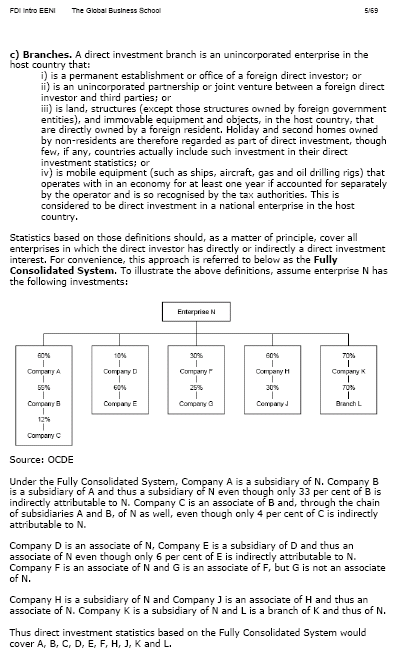
The Economic Cooperation and Development recommends that a foreign direct investment company can be defined as “an incorporated (or unincorporated) company in which a foreign direct investor owns 10% or more of shares (or voting power)”.
The Economic Cooperation and Development analyses the global statistics on foreign direct investment. The OECD Guidelines for Multinational Companies are suggestions addressed by the Governments to the multinational corporations.
The Agreement on Trade-Related Investment Measures (“TRIM Agreement”), one of the Multilateral agreements on trade in products, forbids the international Trade-Related Investment measures (local content requisites).
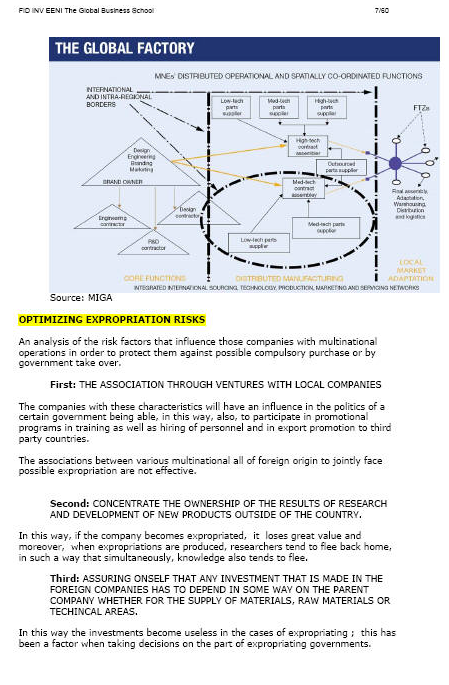
The mission of the Multilateral Investment Guarantee Agency (MIGA) (World Bank Group) is to promote the foreign direct investment in the developing countries to help to support the economic growth, poverty reduction and improve the lives of people.