

Asia Cooperation Dialogue (ACD) Asian Missing Link

Economic and Political Forum (Asia Cooperation Dialogue) China, India
- Introduction to the Asia Cooperation Dialogue (ACD)
- Economic Profile of the members of the Asia Cooperation Dialogue
- Objective of the Asia Cooperation Dialogue (ACD): to create the missing link in Asia by developing an Asian Community
- Effects of the COVID and the global recession in Asia
- Towards an Asian Community
- Areas of cooperation
- ACD Vision for Asia Cooperation 2030
The objectives of the subject “Asia Cooperation Dialogue (ACD)” are the following:
- To learn the goals and structure of the Asia Cooperation Dialogue (ACD)
- To understand the role of the ACD as the “Asian missing link”
- To learn the concept of Asian Community

The Subject “Asia Cooperation Dialogue (ACD)” belongs to the following Online Programs taught by EENI Global Business School:
Masters: International Business, Foreign Trade.


Languages:  or
or  Diálogo de Cooperación de Asia
  Dialogue de coopération asiatique
  Diálogo de Cooperação da Ásia.
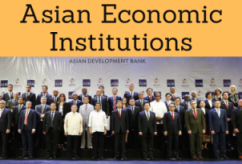
The objective of the Asia Cooperation Dialogue is to set up the “missing link” in Asia by incorporating every Asian Country, and developing an Asian Community without duplicating other institutions or creating a bloc against others.
Sample - Asia Cooperation Dialogue (ACD)
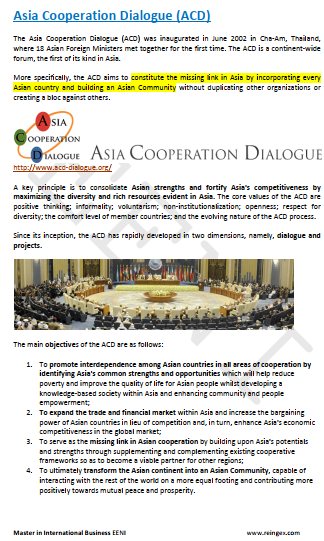
The ACD (Asia Cooperation Dialogue) was created in 2002 in Thailand. The Asia Cooperation Dialogue is an Asian economic and political forum.
The members of the Asia Cooperation Dialogue (ACD) are Afghanistan, Bahrain, Bangladesh, Brunei, Bhutan, Cambodia, India, Indonesia, Iran, Japan, Kazakhstan, Korea, Kuwait, Laos, Malaysia, Mongolia, Myanmar, Pakistan, the Philippines, Oman, Qatar, Saudi Arabia, Singapore, Sri Lanka, Tajikistan, Thailand, Emirates (UAE), Uzbekistan, Kyrgyz Republic, Turkey and Vietnam.
- Nepal is awaiting the accession to the Asia Cooperation Dialogue
- Previous to 2008, the Asian developing countries were mostly insulated from the financial crisis since the kind of refined financial instruments that were affected by the global crisis were predominant primarily in the American and European financial markets
- In fact, there was optimism that national consumption of the emerging economies (India and China) was strong enough for these and other developing economies to have 'de-united' from the fortunes of the developed markets
- Strengths of the Asian Economies also lie in its banking and financial systems, which are now moderately robust after years of restructuring
- The member countries of the Asia Cooperation Dialogue agreed that they would focus their future policies on facilitating international trade of agricultural products between the member countries
The Asia Cooperation Dialogue (ACD) belongs to the Sinic-Buddhist Civilization, Hindu Civilization, and Islamic Civilization.
(c) EENI Global Business School (1995-2024)
We do not use cookies
Top of this page