
Colombo Plan (Asia) Economic Development






 WhatsApp
Colombo Plan for Cooperative Economic and Social Development in Asia
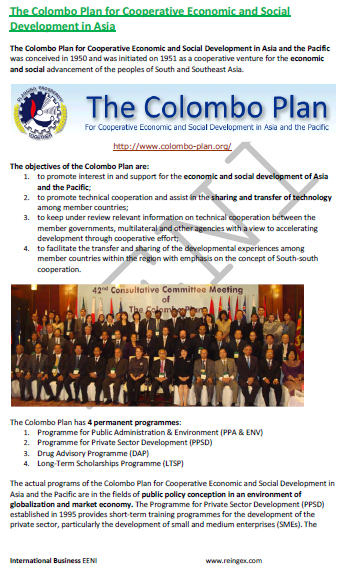
The Colombo Plan for Cooperative Economic and Social Development in Asia and the Pacific was conceived in 1950 and initiated on 1951 as a cooperative venture for economic and social advancement of South and Southeast Asian people.
The members of the Colombo Plan for Cooperative Economic and Social Development in Asia and the Pacific are Afghanistan, Australia, Bangladesh, Bhutan, Brunei, Fiji, India, Indonesia, Islamic Republic of Iran, Japan, South Korea, Laos, Malaysia, Maldives, Mongolia, Myanmar, Nepal, New Zealand, Pakistan, Papua New Guinea, the Philippines, Singapore, Sri Lanka, Thailand, Saudi Arabia, the United States and Vietnam.
- Introduction to the Colombo Plan for Cooperative Economic and Social Development in Asia and the Pacific
- Objectives and Programs of the Colombo Plan
- Organizational Structure of the Colombo Plan
- Asian Economic and Social Development
Sample - Colombo Plan:

The educational aims of the Subject “Colombo Plan” are:
- To understand the purposes of the Colombo Plan for Development of Economic and Social Cooperation in Asia-Pacific
- To analyze the programs of the Colombo Plan
- To learn about economic and social development in Asia-Pacific

The Subject “Colombo Plan” is included within the curriculum of the following academic programs at EENI Global Business School:
Masters: International Business, Foreign Trade.


Languages:  or
or  Plan de Colombo
  Plan de Colombo
Regional groups:
- ASEAN (Association of Southeast Asian Nations)
- South Asian Association for Regional Cooperation (SAARC)
The actual programs of the Colombo Plan for Cooperative Economic and Social Development in Asia and the Pacific are public policy conception, environment, Globalization and Market Economy.
The Colombo Plan belongs to Sinic-Buddhist Civilization, Hindu Civilization, and Islamic Civilization.

(c) EENI Global Business School (1995-2025)
Top of this page
