
International Chamber of Shipping (ICS)






 WhatsApp
International shipping industry: 90% of world trade. Safety, Legal
The International Chamber of Shipping (ICS) is one of the main international organizations of the international shipping industry, representing ship-owners and operators of the sector.
The main functions of the International Chamber of Shipping are related to all technical, legal, labour and political issues of international marine transport.
- Introduction to the International Chamber of Shipping (ICS)
- Objectives of the International Chamber of Shipping
- Key areas: Safety, Legal, Shipping and Trade Policy
- International shipping industry
Sample - International Chamber of Shipping (ICS):

The Subject “International Chamber of Shipping (ICS)” is included within the curriculum of the following academic programs at EENI Global Business School:
Logistics Courses: Multimodal, Transport and Logistics in Africa.
Certificate in International Transport
Masters: International Transport, Transport and Logistics in Africa.


Languages: 
 Cámara Naviera Internacional
 Chambre internationale of the marine marchande
  Câmara Internacional of Navegação.
Area of Knowledge: Foreign Trade - Incoterms.

International Chamber of Shipping (ICS).
The purpose of the International Chamber of Shipping is to promote interests of ship-owners and operators in all matters related to Maritime transport policy and ship operations.
There are more than 50,000 merchant ships operating internationally, transporting all types of cargo. The world fleet is registered in more than 150 nations and is manned by more than one million sailors of virtually all nationalities.
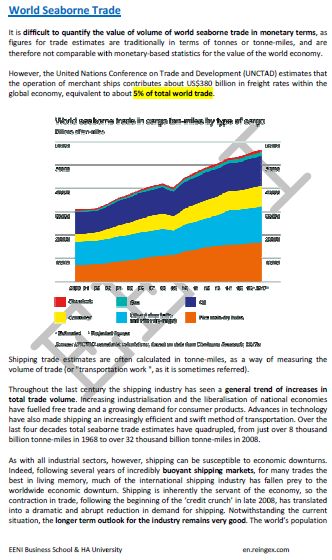
The international shipping industry is the responsible for transportation of around 90% of world trade.
- The International Chamber of Shipping was founded in 1921
- Its headquarters are in London (UK)
- The International Maritime Organization (IMO) is associated with the International Chamber of Shipping
Members of the International Chamber of Shipping: Australia, Bahamas, Belgium, Brazil, Canada, Chile, China, Cyprus, Denmark, Faroe Islands, Finland, France, Germany, Greece, Hong Kong, India, Ireland, Italy, Japan, Kuwait, Liberia, Mexico, Netherlands, Norway, Philippines, Portugal, Russia, Singapore, South Korea, Spain, Sweden, Switzerland, Turkey, UK, U.S..
The BIC Code (International Identification Codes of Container Owners) is accepted by the International Chamber of Shipping:
Trade Facilitation - Trade Facilitation Agreement - Kyoto Convention (Containers) - Convention Harmonization of Frontier Controls of Goods.

(c) EENI Global Business School (1995-2025)
Top of this page
