
Canada-EFTA Free Trade Agreement






 WhatsApp
FTA Agreement, Canada, European Free Trade Association
- Introduction to the Canada-EFTA Agreement
- International Trade between Canada and EFTA States
Sample - Canada-EFTA Free Trade Agreement (FTA)

The Subject “Canada-EFTA Agreement” is included within the curriculum of the following academic programs at EENI Global Business School:
Masters: International Business, Foreign Trade.


Languages:  or
or  Canada AELE
  Canada
  European Free Trade Association (EFTA).

Canada-EFTA Free Trade Agreement.
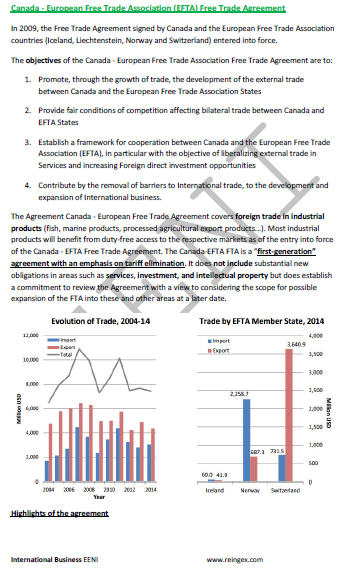
In 2009, the Free Trade Agreement signed by Canada and EFTA Countries (Iceland, Liechtenstein, Norway, and Switzerland) entered into force.
The objectives of the Canada-European Free Trade Association Free Trade Agreement are to:
- Promote, through trade growth, external trade development between Canada and the European Free Trade Association States
- Provide fair conditions competition affecting bilateral trade between Canada and EFTA States
- Establish a Framework for Cooperation between Canada and EFTA, in particular with the objective of liberalizing Foreign Trade in Services and increasing Foreign Direct Investment opportunities
- Contribute to remove trade barriers, development, and expansion of International Business
The Agreement Canada-EFTA covers Foreign Trade in industrial products (fish, marine products, processed agricultural export products).
Most of the industrial Products will benefit from duty-free access to the respective markets as of the entry into force of the Canada-EFTA Free Trade Agreement.

Summary of the Canada-European Free Trade Association Free Trade Agreement.
Trade in products:
- National Treatment
- Import and export Restrictions
- Sanitary and Phytosanitary Measures
- Technical regulations
- Rules of Origin and administrative cooperation
- Sub-Committee on Rules of Origin and Trade in Products
- Customs duties
Trade in Services and Foreign Direct Investment.
- Foreign Trade in services and investment
- Temporary entry
Other common rules:
- Subsidies
- Anti-dumping
- State trading companies
- Public procurement
- Trade Facilitation
Exceptions and Safeguards
The European Free Trade Association countries are an important trading partner for Canada
Canada belongs to the North American Economic Area (Western Civilization) and EFTA to the European Economic Area.
(c) EENI Global Business School (1995-2025)
Top of this page
