
APEL for a Doctorate in International Business





 WhatsApp
Enter a DIB without a master’s degree / APEL (Accreditation of Prior Experiential Learning)
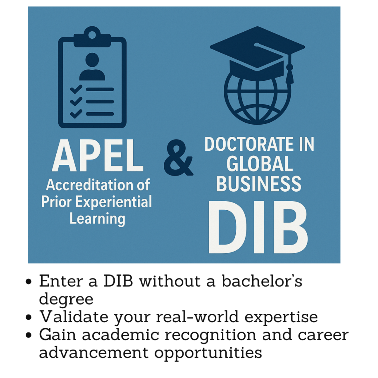
APEL (Accreditation of Prior Experiential Learning) is a pathway that allows individuals to gain academic credit—or even direct entry—into a degree program based on their prior work experience, professional achievements, and informal learning. For a Doctorate in International Business (DIB), APEL is typically aimed at experienced professionals who can demonstrate substantial, relevant expertise in Global Business environments.
APEL is designed to provide an alternative pathway for individuals who may lack formal academic qualifications but have substantial professional experience relevant to their desired field of study. It involves the identification, documentation, and assessment of prior learning to determine its equivalence to academic credits or program entry requirements. In the context of a DIB, APEL allows experienced professionals, such as managers, entrepreneurs, or executives, to leverage their International Business experience to meet admission criteria or reduce coursework requirements.
Types of APEL:
- 1. APEL.A (Access): Used for admission to a program, such as a DIB, for those who do not meet standard academic entry requirements but have relevant professional experience.
- 2. APEL.C (Credit): Allows credits to be awarded toward specific modules or courses within a program, excluding final-year projects or dissertations in some cases.
International Equivalents:
- UK: APEL / APL (Accreditation of Prior Learning)
- USA/Canada: PLA / RPL (Prior Learning Assessment)
- France: VAE (Validation des Acquis de l’Expérience)
- Spain/Latin America: Reconocimiento de Aprendizajes Previos (RAP)
- Portugal, Brazil, Angola...: Reconhecimento de Aprendizagem Prévia (RAP)
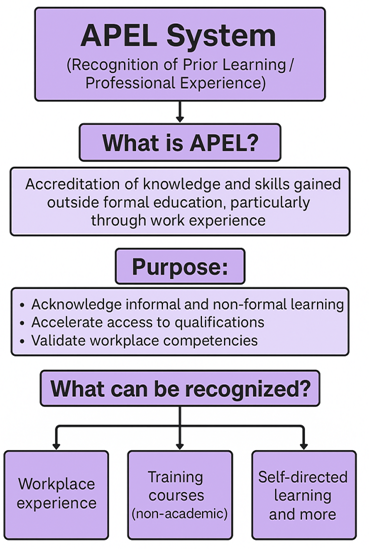
Purpose of APEL: To widen access to higher education, recognize experiential learning, and reduce the time and cost of completing a degree by granting credits or entry based on demonstrated competencies.

APEL for a DIB recognizes and assesses non-formal and experiential learning that aligns with the academic requirements of a doctorate.
Benefits of APEL for DIB:
- Accessibility: Enables professionals without formal academic qualifications to pursue a doctorate, making higher education more inclusive.
- Time and Cost Efficiency: Reduces the duration and cost of the program by granting credits for prior learning.
- Career Advancement: Validates professional expertise, enhancing credibility for executive roles, consultancy, or academic positions in International Business.
- Graduates can pursue roles like global policy analyst, international marketing manager, or C-suite executive.
A Doctorate in International Business (DIB) is a high-level, research-based degree aimed at professionals seeking advanced expertise in global markets, cross-cultural management, International Trade, and strategic leadership. APEL can facilitate access to such programs, particularly for candidates with significant professional experience but without the typical academic prerequisites (e.g., a master’s degree).
EENI Doctorates:
- Doctorate in World Trade
- Doctorate in Global Transportation & Logistics
- Doctorate in Global Ethics, Religions, and International Business
- Doctorate in African Business
- Doctorate in Asian Business
- Doctorate in Islamic Business
- Doctorate in European Business
- Doctorate in American Business
A DIB program typically includes coursework (e.g., global strategy, international finance), research methodology, and a dissertation or doctoral research project. APEL can reduce coursework requirements, allowing candidates to focus on research.
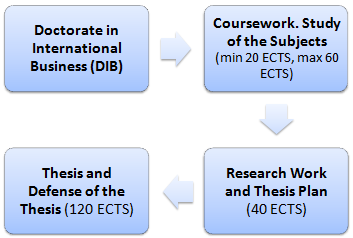
Typical DIB Curriculum and APEL’s Impact
A DIB program generally includes:
- Coursework: Topics like International Marketing, global supply chain management, cross-cultural communication, and international finance.
- Research Methods: Training in qualitative and quantitative research to prepare for the dissertation.
- Dissertation/Research Project: An original contribution to International Business knowledge, such as a study on global market trends or cross-cultural management strategies.
With APEL:
- Coursework Reduction: Credits may be awarded for modules based on experience (e.g., a candidate with 10 years in global logistics might receive credits for supply chain management courses).
- Admission Flexibility: Professionals with extensive experience but no master’s degree can gain entry through APEL.A.
- Focus on Research: APEL allows candidates to focus on the dissertation or research project, leveraging their practical expertise to address real-world business challenges.
Career Outcomes
A DIB with APEL equips graduates for:
- Executive Roles: CEO, COO, or Global Business director in multinational corporations.
- Consulting: International management consultant or global policy analyst.
- Academia: Teaching or research positions at universities, focusing on International Business.
- Entrepreneurship: Leading global startups or expanding businesses internationally.

- Candidates typically need at least 5 years of demonstrable professional experience in management or International Business roles.
- Experience in areas like International Trade, global marketing, logistics, cross-cultural management, or multinational corporate strategy is highly relevant. For instance, roles such as International Marketing or logistics manager, global policy analyst, or corporate investment banker align well with DIB objectives
- Documented success in areas such as International Trade, cross-border mergers, global marketing strategy, international expansion, global logistics, or cross-cultural leadership.
- Industry contributions such as white papers, consultancy work, professional publications, or speaking engagements.
- Possibly some postgraduate education, even if not directly in International Business.
APEL Application Component
1. Personal Statement / Reflective Report
- Explain why you're applying via APEL.
- Demonstrate how your experience equates to doctoral-level learning.
- Align your experience with the intended learning outcomes of the DIB.
Sample APEL Statement Opening
"Over the past 15 years, I have led the international expansion strategies of multiple firms across Southeast Asia and Europe, navigating complex trade regulations, managing culturally diverse teams, and launching market-specific branding campaigns. This hands-on experience has given me not only a deep understanding of International Business practices but also the strategic foresight and critical reflection skills aligned with doctoral-level competencies. Through this APEL application, I aim to formally recognize this body of knowledge as the foundation for pursuing advanced doctoral research.”
2. Portfolio of Evidence
- CV/resume with detailed work history.
- Case studies or project reports.
- Publications or thought leadership pieces.
- Evidence of business impact (metrics, strategic decisions, outcomes).
- Testimonials or reference letters (from senior professionals, partners, clients).
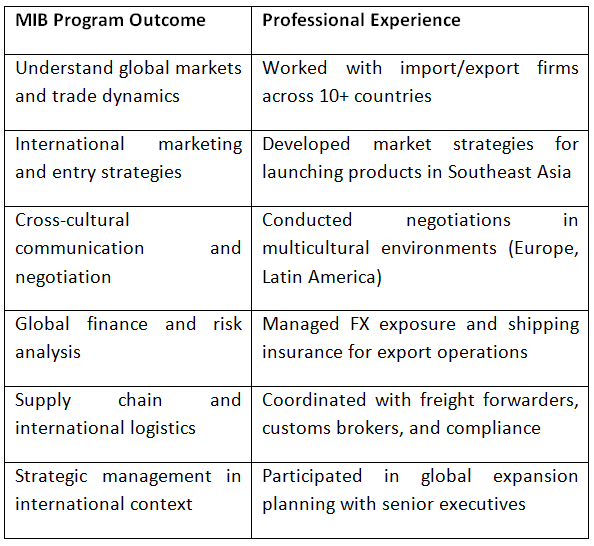
3. Mapping to Program Learning Outcomes
- Identify how your experiential learning meets the doctoral program’s requirements.
- Address research skills, theoretical knowledge, and critical thinking competencies.
4. Interview or Presentation
Often required to defend your portfolio and readiness for doctoral research.
Example Learning Outcomes to Map (DIB Focus)
- Strategic thinking in complex Global Business environments.
- Deep understanding of international market dynamics.
- Ability to critically apply International Business theories in real-world settings.
- Proficiency in identifying global trends and leading cross-cultural teams.
- Research capability for applied or theoretical contributions to international business.
Tips for Success
- Be evidence-driven, not just descriptive.
- Emphasize strategic contributions, not just operational tasks.
- Use academic language where appropriate (e.g., referencing international business frameworks or concepts).
- Make sure your experience aligns with the doctoral level—analytical, reflective, strategic, and research-oriented.
APEL Application Template for Doctorate in International Business (DIB)
Cover Letter
[Your Name]
[Your Address]
[City, Zip Code]
[Email Address]
[Phone Number]
[Date]
Admissions Committee
EENI Global Business School
Doctorate in International Business (DIB) Program
Dear Members of the Admissions Committee,
I am writing to formally apply for admission to the Doctorate in International
Business (DIB) program through the Accreditation of Prior Experiential Learning
(APEL) route. With over [X] years of experience in Global Business strategy,
market expansion, and international operations, I have accumulated extensive
experiential knowledge that aligns with the competencies expected of
doctoral-level study.
This application includes a detailed reflective report, a portfolio of
supporting evidence, and a proposed research outline. I trust my experience and
demonstrated learning outcomes will meet the requirements of APEL entry.
Thank you for considering my application.
Sincerely,
[Your Name]
Curriculum Vitae (Attach as a separate document)
Ensure it includes:
- Academic qualifications
- Professional roles (especially with international scope)
- Key projects, achievements
- International collaborations
- Professional memberships and certifications
- Conferences, presentations, publications
Reflective Report
Title: Reflective Report on Experiential Learning in International Business
1. Introduction
Briefly introduce your background and motivation for applying to the DIB program
via APEL.
2. Summary of Professional Experience
Outline your career journey with focus on International Business functions.
Example:
"From 2012 to 2024, I served as Regional Business Development Director at [Company], overseeing market entries in Southeast Asia, leading cross-border joint ventures, and negotiating trade agreements...”
3. Experiential Learning
Use a reflective framework (e.g., Kolb’s Learning Cycle: Experience → Reflect →
Conceptualize → Apply) to describe how you developed doctoral-level knowledge
and skills.
Demonstrated Competencies Aligned with Doctoral-Level Outcomes
You may structure this like:
Doctoral Competency → Evidence & Reflection
Strategic Thinking in global markets → Led a $10M market expansion project in
Latin America, involving in-depth PESTLE analysis, stakeholder negotiations, and
strategic risk assessment.
Research & Analytical Skills → Conducted market feasibility studies, developed
econometric models to assess international pricing strategies.
Innovation & Problem Solving → Designed a digital export platform for SMEs,
improving time-to-market by 35%.
Academic Writing & Presentation → Published two white papers on global logistics
trends; presented at the 2023 World Trade Forum in Geneva.
Personal and Professional Development
Reflect on how these experiences shaped your intellectual growth and readiness for doctoral research.
Portfolio of Evidence
Organize as a table (attached documents should be referenced here):
Evidence No. → Description → Relevance to DIB
Doc 1 → International Expansion Strategy Report – Asia → Demonstrates strategic
planning and cross-cultural insight
Doc 2 → Global Trade Compliance Audit → Reflects operational knowledge of
International Business law
Doc 3 → Presentation at Global Business Conference (Slides) → Academic and
professional dissemination
Doc 4 → Client Testimonial – EU Market Entry Project → Third-party validation of
strategic impact
Doc 5 → Certificate – International Business Negotiation → Formal learning
complement
Learning Outcomes Mapping Table
Map your experience to the doctoral program’s learning outcomes:
DIB Learning Outcome / Supporting Evidence (Doc #) / Page / Section
Demonstrate advanced knowledge of Global Business / Doc 1, Doc / 2 p. 3, p. 7
Apply research methodology to real-world problems / Doc 3, Doc 5 / Slides 12–15
Communicate complex ideas effectively / Doc 3 Entire
Develop solutions to cross-cultural business issues / Doc 1, Doc 4 / Exec Summary
Proposed Research Outline (Optional, Strongly Recommended)
Title: Digital Trade Facilitation and SME Competitiveness in Emerging Markets
Explain the gap in current knowledge or practice.
Objectives
- To assess how digital tools affect trade efficiency for SMEs
- To evaluate barriers and enablers in adopting digital trade technologies
Methodology (Brief):
Qualitative case studies + survey data + policy analysis
Contribution to International Business:
Addresses the intersection of technology, trade policy, and SME globalization.
Letters of Support (Attach separately)
Include at least two:
- From former employers, business partners, or senior colleagues.
- Must address your capabilities for doctoral research and international business expertise.
Fees
The candidate must submit this document for evaluation to EENI. The evaluation fee is 300 Euros. If the candidate is accepted to study the Doctorate, this amount will be deducted from the total tuition fee. If the candidate is not accepted, this amount will NOT be refunded.
Payment methods: Online, Western Union, or Bank Transfer.

(c) EENI Global Business School (1995-2025)
Top of this page
