Master in Foreign Trade Back Office
Professional Master in Foreign Trade Back Office (60 ECTS, eLearning)
The Online Master of Science (MSc) in Foreign Trade Back Office taught by EENI Global Business School is designed to provide all the necessary knowledge to assume all the responsibilities related to the management of the Back Office of an exporting or importing company.
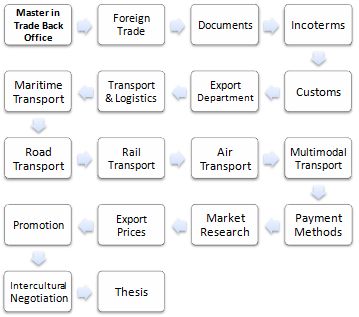
The Master's Degree consists of 17 modules:
- Introduction to the Foreign Trade (1)
- Foreign Trade Documentation Management (1)
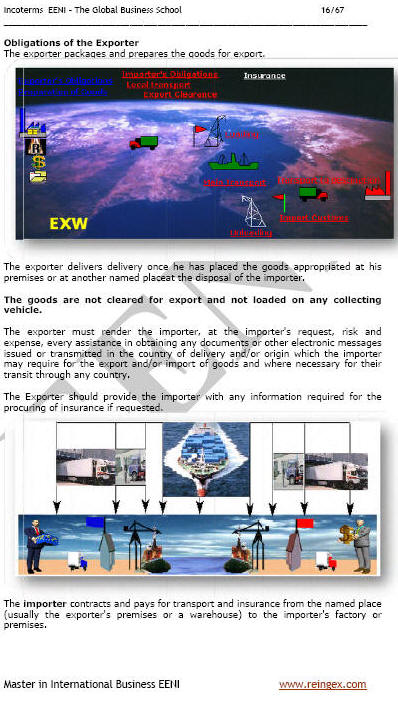
- Incoterms® 2020 (2)
- Customs (3)
- Export Department (1)
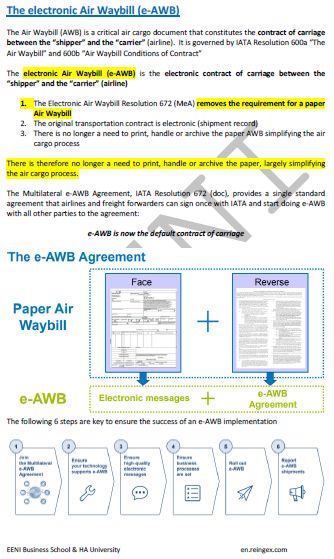
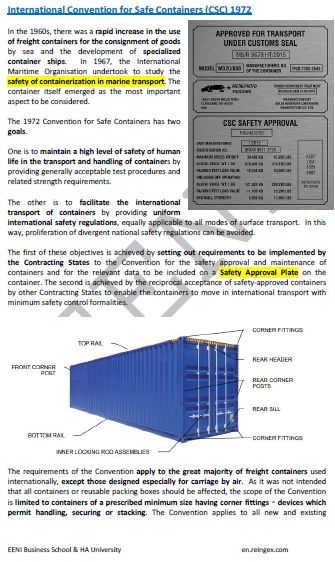
- International Transport and Logistics (5)
- Maritime Transport (5)
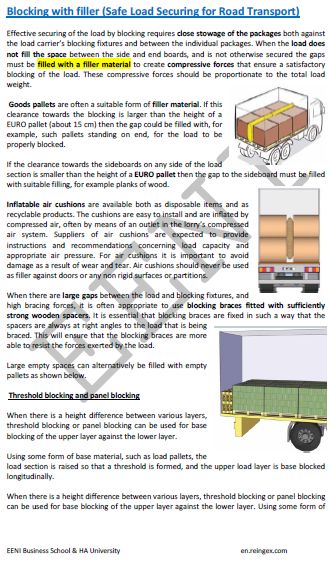
- Road Transport (10)
- Rail Transport (5)
- Air transport (4)
- Multimodal Transport (5)
- International Payment Methods. Documentary credits (3)
- International Market Research (2)
- Export Prices Calculation (1)
- International Promotion (4)
- Intercultural Management (2)
- Master's Thesis (6)
Parentheses indicate the ECTS = European Credit Transfer and Accumulation System
The Master's Degree in Foreign Trade Back Office is also aimed at all those people who wish to create their own company offering Export / Import Back Office services to the export companies from anywhere in the world.
 Enrol / Request for Information

- Credits: 60

- Duration: 1-year It is recommended to dedicate about twelve hours of study per week following a flexible schedule. It is possible to reduce the duration dedicating more hours a week
- Tuition Fees: € 1,000
- Open Online Enrollment
- Download the Admission Form
- Frequently Asked Questions (FAQ)
Language of the Master: 


The Back Office (or support office) includes all those administrative activities that support the foreign trade department (Front Office) that are provided directly without a necessarily direct contact with the client.
Some of the functions carried out by a Foreign Trade and International Transport Back Office are the management and monitoring of the international orders, customs procedures, foreign trade documentation, documentary management of exports and imports, international offers preparation, logistics management of the foreign trade (monitoring, analysis, transport rates negotiation), customer service, incident resolution, export and import control, international operations activity reports, international market research, support for the export director in international travels, support in the international fairs Organization, export costs control...
In other words, the responsible of the Foreign Trade and International Transport Back Office guarantees the foreign trade flows (products / services) and manages the processes related to the global supply chain of the exporting company, reporting directly to the Foreign Trade Director.
Unlike a Back Office for the national market, the responsible of the Foreign Trade Back Office must have a solid knowledge of the international trade: Incoterms, customs, documentary management of the foreign trade, international transport and logistics, export collection (documentary credits), international market research, international promotion, export prices calculation, intercultural negotiation...
In addition, the person in charge of the Foreign Trade Back Office must be fluent in languages. The usual thing is to be bilingual (English and Spanish), or even has a fluency of other languages such as French or Portuguese.
Therefore, you can study the Master's Degree in Foreign Trade Back Office in any of these four languages, under three modalities:
- Only one language (for example, English or French)
- Bilingual (for example, English + Spanish): the master is studied in both languages, and the exercises and theses are done in Spanish. The Master's Degree diploma will indicate: Bilingual English and Spanish
- Trilingual (for example, English + Spanish + French): the master is studied in all three languages, half of the exercises are done in Spanish and the other half in French. The thesis can be done in Spanish or French. The Master's Degree will indicate: Trilingual English, Spanish and French
The student has to pass the online continuous assessment exercises for each subject as well as the final online Master's Thesis. If the professor considers that the minimum level has not been reached, he will guide the student to improve the quality of his exercises or thesis and send them back.
The most important thing for EENI is that the student correctly learns the Master's subjects and objectives.
Once all the exercises and thesis have been approved, the student obtains the “Diploma of Professional Master of Science (MSc) in Foreign Trade Back Office” issued by EENI Global Business School.
In this case, it will be necessary to send us by mail (not valid by email) a certified photocopy of your diploma of Bachelor's Degree. This is necessary for the issuance of your diploma and not to enroll.
Those students, who are not in possession of a Bachelor's Degree, may Enroll but will receive the “Advanced Certificate Program in Foreign Trade Back Office.”
The subjects of the Master are part of the following Higher Education Programs taught by EENI: