
Singapore-Panama Agreement


Singapore-Panama Free Trade Agreement
- Introduction to the Singapore-Panama Agreement
- Foreign Trade in Goods, Services, and Investment
- Benefits to the Singaporean Exporters
- International Trade between Singapore and Panama
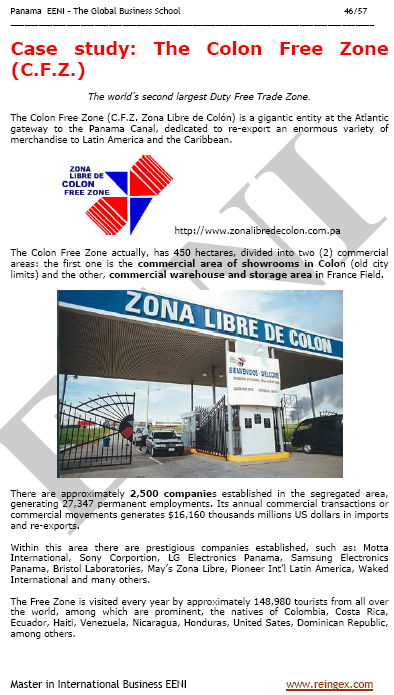
- Colon Free Zone (Panama)

The Subject “Singapore-Panama Free Trade Agreement” belongs to the following Online Programs taught by EENI Global Business School:
Masters: International Business, Foreign Trade.

Languages:  or
or  Panamá-Singapur
  Singapour.
Singapore-Panama Free Trade Agreement
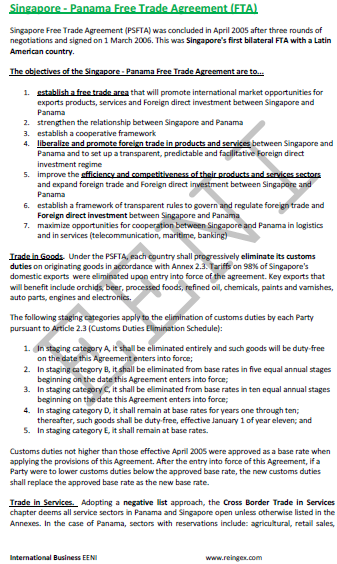
The Singapore-Panama Free Trade Agreement (FTA) entered into force in 2006.
The objectives of the Singapore-Panama Free Trade Agreement are to:
- Establish a free-trade area that will promote the market opportunities for the exports products, services, and foreign direct investment between Singapore and Panama
- Strengthen the relationships between Singapore and Panama
- Establish a cooperative framework
- liberalize and promote the foreign trade in products and services between Singapore and Panama and to set up a transparent, predictable and facilitative Foreign direct investment regime
- Improve the efficiency and competitiveness of their goods and services sectors and expand the international trade and foreign direct investment between Singapore and Panama
- Establish a framework of transparent rules to govern and regulate the foreign trade and Foreign direct investment (FDI) between Singapore and Panama
- Maximize the opportunities for the cooperation between Singapore and Panama in logistics and services (telecommunication, maritime, banking)
The Singapore-Panama Free Trade Agreement covers:
- Market access for International trade in goods
- Cross-border Trade in Services
- Financial services
- Telecommunications
- E-commerce
- FDI
- Competition
- Government Procurement
- Dispute Settlement
The Singapore-Panama Free Trade Agreement also has opened up Government procurement.
Chapters of the Singapore-Panama Free Trade Agreement.
- International Trade in goods
- Rules and certificate of origin
- Customs Procedures
- Sanitary and Phytosanitary Measures
- Technical Barriers to Trade (TBT)
- Competition Policy
- Government Procurement
- FDI
- Cross-border Trade in Services
- Financial Services
- Telecommunications
- E-Commerce
- Transparency
- Dispute Settlement
- Strategic Partnership
Sample - Singapore-Panama Free Trade Agreement (FTA)
Foreign Trade Singapore-Panama.
- The Republic of Panama is the largest trading partner of Singapore in Latin America (Iberian America)
- Foreign trade: SGD 4.3 billion (30% growth over the previous year)
Panama belongs to the Latin American Economic Area and Singapore to the Sinic Civilization.
(c) EENI Global Business School (1995-2024)
We do not use cookies
Top of this page