
Singapore-Australia Agreement


Singapore-Australia Free Trade Agreement
- Introduction to the Free Trade Agreement between Australia and Singapore
- Foreign Trade in Goods, Services, and Investment
- Rules of Origin

The Subject “Singapore-Australia Free Trade Agreement” belongs to the following Online Programs taught by EENI Global Business School:

Masters: International Business, Foreign Trade.
Languages:  or
or  Australie
  Singapur-Australia.
Singapore-Australia Free Trade Agreement.
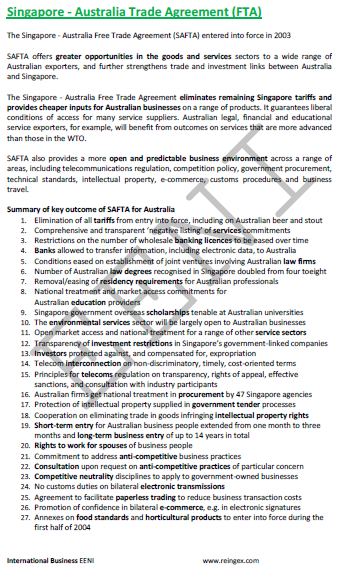
The Singapore-Australia Free Trade Agreement (FTA) entered into force in 2003.
The main benefits of the Singapore-Australia Free Trade Agreement are:
- Elimination of all the import tariffs
- All the exported products will be able to benefit from a zero-tariff treatment
- Restrictions on banking licences
- Fewer requisites on Joint Ventures creation
- Residency requisites removal
- Agreement to facilitate the foreign trade paperless
The Singapore-Australia Free Trade Agreement covers:
- Foreign Trade in products and services
- FDI
- Tariff Reduction
- Rules and certificate of origin
Foreign trade between Singapore and Australia.
- The Republic of Singapore is the largest trade and investment partner of Australia in the ASEAN region and sixth largest trading partner of Australia
- Australia ranked eighth among the principal export product destinations of the Republic of Singapore and 17th among its primary import product sources
- Exported products from Australia to the Republic of Singapore: 4.8 billion dollars (the ninth largest export market)
- Imports from the Republic of Singapore: 10.7 billion dollars (the fifth-largest source)
- Services are a significant part of the foreign trade, with the Australian service exports to the Republic of Singapore valued at 2.6 billion dollars (the sixth largest export market) and imports at 3.5 billion dollars (the third largest source)
The Singapore-Australia Free Trade Agreement is an inter-civilization agreement between Oceania (Western Civilization) and Sinic Civilization.
Sample - Singapore-Australia Free Trade Agreement (FTA)
(c) EENI Global Business School (1995-2024)
We do not use cookies
Top of this page