EENI
Business School

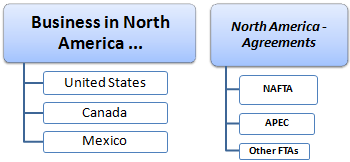
Course: Business in North America (United States Canada Mexico NAFTA)

EENI Home EENI International Business - America - Foreign Trade Courses

International business

Master International Business


Certificate program Doing business in North America - Syllabus:


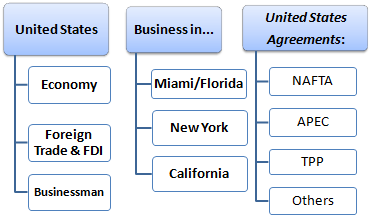
M Business in United States

United States economy

- Introduction to the United States of America.
- United States economy.
- United States market overview. Main sectors.
- U.S. Exports of goods and services.
- Case study: Top 20 Metropolitan Area exporters.
- Foreign direct investment (FDI). Case study: Asian-Pacific FDI in the United States.

Doing Business in California

- California: eighth largest economy in the world.
- Regions of California.
- Doing business in Los Angeles.
- Case study: News corporation.
- The Silicon Valley.
- Players: Adobe, AMD, Apple, CISCO, eBay, HP, Oracle, Yahoo, Symantec, Intel.
- Doing business with Los Angeles County.

Doing Business in Florida

- About Florida.
- The economy of Florida and Miami.
- Economic profile of Florida’ s regions.
- Foreign Trade. International Advantages of Florida.
- Foreign Direct Investment (FDI) in Florida.
- Florida industry clusters.
- Doing business in Miami.
- Setting up Business in Florida: Corporations and Limited Liability Company (LLC)
- Case study: Burger King.

Doing Business in New York

- New York City’s economy.
- Central business districts (CBDs).
- The global capital of fashion. Case study: Ralph Lauren, Liz Claiborne, Jones Apparel Group.
- Professional services. Case: Omnicom Group Inc.
- Manufacturing and industrial.
- High Tech economy. Nanotechnology. Bioscience.
- Distribution sector.
- Establishing a business in New York City.

US Free Trade Agreements (FTA)

- North American Free Trade Agreement (NAFTA).
- Asia-Pacific Economic Cooperation (APEC) ©.
- US Free trade agreements (FTA): Australia, Bahrain, Canada Mexico (NAFTA), Chile, Colombia, Costa Rica, Dominican Republic, El Salvador, Guatemala, Honduras, Israel, Jordan, Korea, Morocco, Nicaragua, Oman, Panama, Peru (TPA), Singapore.
- Free Trade Agreements Tariff Tool.
- European Union - US Trade Relations (TEC).
- Trade Investment Framework Agreements (TIFAs). ASEAN - US.
- Bilateral Investment Treaties (BIT).
- Trans-Pacific Strategic Economic Partnership Agreement (TPP).
- AGOA - African Growth and Opportunity Act. U.S. Africa trade.
- Regional Institutions: PECC, IADB, ESCAP, ECLAC, OEA, RCC.

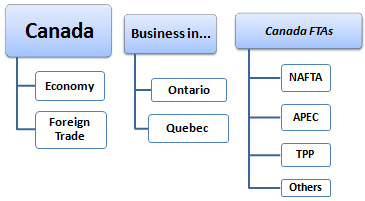
M Doing Business in Canada

- Introduction to Canada.
- Canadian economy. Competitive Advantages. FDI in Canada.
- Foreign trade: exports and imports.
- Case study. Canada’s industry sectors: aerospace, Agri-food, Automotive, Software ...
- Doing business in Ontario - Toronto.
- Doing business in Quebec.
- Case study: the Asia-Pacific gateway and corridor initiative (APGCI).

Canada Free Trade Agreements (FTA)

- NAFTA, APEC.
- IDB, ECLAC, OEA, PECC, UNECE, RCC.
- Free Trade Agreements with Honduras, Panama, Jordan, Colombia, Peru, EFTA, Costa Rica, Chile, Israel.
- Ongoing FTA Negotiations : Andean Community, CARICOM, Central America (CA4), Dominican Rep., European Union, India, Korea, Morocco, Singapore, Ukraine, Turkey.
- ASEAN Canada Economic Cooperation Agreement (ACECA). India (CEPA)
- Foreign Investment Promotion and Protection (FIPAs).

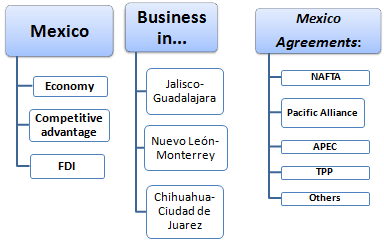
M Doing Business in Mexico

- Introduction to Mexico.
- Mexican economy. Foreign trade: exports and imports.
- Strategic sectors: software, agribusiness, plastic, footwear, ...
- Setting up business.

Key sectors of the Mexican economy

- Mexican Aerospace Industry.
- Automotive sector.
- Agribusiness sector. Case study: Acquisition of FEMSA by Heineken.
- Creative Industries.
- Medical Device.
- Household Appliances industry. Case study: Bosch Group in Mexico.
- Electronics Industry.
- Renewable Energy.
- Information Technology market (IT, BPO, Software).

Competitive Advantage of Mexico

- Competitive Advantage of Mexico.
- Ease of doing business in Mexico.
- International Competitiveness of Mexico.
- Ranking of competitiveness of Mexico states.

Foreign Direct Investment (FDI) in Mexico

- Framework for Foreign Direct Investment (FDI) in Mexico.
- Overview of FDI in Mexico.
- Changes and Trends in FDI.
- FDI by sector, Mexican states and Country.
- Incentives for Foreign Investment.
- Agreements on Reciprocal Promotion and Protection of Investments (RIPPA).

Doing Business in Jalisco - Guadalajara

- The state of Jalisco.
- Economy of Jalisco. Foreign Trade. FDI.
- Guadalajara’s advantages in the global economy.
- Doing Business in Guadalajara: Mexico's "Silicon Valley".
- Key sectors: Automotive, Aerospace, Electronics Contract Manufacturing, Electronic Design, Software and BPO services.
- Case study: Kaxan Media Group. Arion Group.

Doing Business in Nuevo Leon Monterrey

- The State of Nuevo Leon.
- Economy Nuevo Leon. Foreign Trade.
- Foreign Direct Investment (FDI) in Nuevo Leon.
- Doing Business in Monterrey: the industrial capital of Mexico.
- Competitive advantages of Nuevo Leon.
- Clusters in Nuevo Leon: automotive, Home Appliance, Aerospace, Health care, IT Industry.
- Major industrial groups in Nuevo Leon.
- Case study: CEMEX. Grupo FEMSA. ALFA. Gruma.

Doing Business in Chihuahua

- The State of Chihuahua.
- The Economy of Chihuahua. Foreign Trade.
- Foreign Direct Investment (FDI).
- Maquiladora Industry.
- Doing Business in City of Chihuahua and Ciudad de Juarez.
- Casos de estudio: Interceramic, Grupo BAFAR. Aerospace Industry.

Mexico Free Trade Agreements (FTA's)

- APEC, ALADI, AEC.
- SELA. Mesoamerica Project. PEEC.
- North American Free trade agreement (NAFTA).
- TLCUEM Mexico - European Union.
- Free trade agreements of Mexico: Colombia, Costa Rica, Nicaragua, Isreal, Northern Triangle (El Salvador, Guatemala and Honduras), EFTA, Uruguay, Japan, Chile.
- Andean Community (Associate). Agreements Mexico - CAN.
- Mexico - Mercosur Economic Complementation Agreement (ACE).
- Peru - Mexico Trade Integration Agreement.
- Economic Complementation Agreements of Mexico.

M Request Information of the certificate program Doing business in North America.

M Duration: 8 weeks

Course objectives:
The main objective of the "Certificate program Doing business in North America" is to provide an overview of the region´s economy and business opportunities.

- To learn to do business in USA, Canada and Mexico.
- To understand the impact NAFTA and the Free Trade Agreements in the region.
- To know where to find information.

Addressed to: the "Certificate program Doing business in North America" is intended for all those wishing to specialize in North American markets.

M Course tutors:
TurkAudician

M Course learning materials: En
Also available in: Es Negocios en América del Norte

Communication with tutors (student's questions, exercises ...) in: En Fr Pt Es

Methodology: e-learning / Distance learning.

M Educational level: Continuing education / Executive education programs.

M Related courses and mastersMaster Business in the Americas - Master Business in Latin America - Master Business Asia Pacific Region.

Free Trade Agreements affecting the markets analyzed in the course "Doing business in the North America"


View all content - Contract

M North American Free Trade Agreement (NAFTA)

- The North American Free trade agreement (NAFTA).
- NAFTA institutions. Free Trade Commission. NAFTA background.
- NAFTA rules of origin.
- Economic facts about NAFTA.
- Success Stories.

Asia-Pacific Economic Cooperation (APEC) ©

- Introduction to Asia-Pacific Economic Cooperation (APEC) ©.
- Structure. Bogor Goals. Osaka Action Agenda.
- Trade and Investment Liberalisation. Business Facilitation. Economic and Technical Cooperation.
- Achievements and benefits.

M United States Free Trade Agreements

US - Australia FTA

- United States - Australia Free Trade Agreement (FTA).
- Advantages for Australian and US Exporters.
- US - Australia Trade in goods and services.
- Australia's trade and investment with individual US States.
- Analysis of the U.S. - Australia Free Trade Agreement.
- National Treatment and Market Access for Goods. Agriculture. Textiles and Apparel. Rules of Origin. Sanitary and Phytosanitary Measures, Cross-Border Trade in Services, Investment.

US - Korea FTA

- U.S. - Korea Free Trade Agreement (KORUS FTA).
- Benefits of the FTA for US and Korean exporters.
- FTA's Advantages for agriculture, manufacturing, Automotive, High-Tech Industry, services, Financial Services.
- Investment and the U.S.-Korea FTA.
- Case study: US SME’s exporting to Korea.
- Structure of the FTA. Rules of Origin. Regional Value Content.

US - Singapore FTA

- The United States - Singapore Free Trade Agreement (USSFTA).
- Trade in Goods and Services. Rules of Origin. Market Access. Investment. Government Procurement.
- Intellectual Property Rights (IPR).
- Benefits to Singaporean and US Exporters.
- Leading sectors for U.S. exports in Singapore.
- US Singapore trade relations.

US - Chile FTA

- The United States - Chile Free Trade Agreement (FTA).
- U.S. trade relations (Goods and Services) with Chile.
- Benefits to U.S. Agriculture.
- Investment. Intellectual Property Rights (IPR).
- Structure of the US-Chile FTA.

The Andean Trade Promotion and Drug Eradication Act (ATPDEA)

- The Andean Trade Promotion and Drug Eradication Act (ATPDEA).
- U.S. Trade with ATPA/ATPDEA Countries (Bolivia, Colombia, Ecuador, and Peru).

US - Colombia FTA

- U.S. - Colombia Free Trade Agreement.
- Main benefits of the United States - Colombia Trade Agreement.
- US Colombia trade relations.
- Business Opportunities for U.S. exporters in Colombia. Strategic sectors.
- Access to Colombian market. Steps for importing to Colombia.
- Structure of the FTA.

US - Peru TPA

- United States - Peru Trade Promotion Agreement.
- Business opportunities for U.S. exporters.
- U.S. Peru trade relations.
- Structure of the FTA.

US - Panama FTA

- United States - Panama Free Trade Agreement (FTA).
- Benefits of the U.S.-Panama Trade Promotion Agreement.
- U.S. Panama trade relations.

CAFTA-DR United States - Central America- Dominican Rep FTA

- Dominican Republic - Central America - United States Free Trade Agreement (CAFTA-DR).
- US- Central America (Costa Rica, El Salvador, Guatemala, Honduras, and Nicaragua) trade relations.
- Benefits of the CAFTA-DR.

US - Bahrain FTA

- United States Bahrain Free Trade Agreement (FTA).
- Main benefits of the FTA.
- US Bahrain Trade relations.
- Business opportunities of US exporters.
- Summary of the US-Bahrain FTA.

US - Oman FTA

- United States Oman Free Trade Agreement (FTA).
- Main benefits of the FTA.
- Business opportunities of US exporters.
- Summary of the US-Oman FTA.

US Jordan FTA

- United States Jordan Free Trade Agreement (FTA).
- Main benefits of the FTA.
- Qualifying Industrial Zones.

US - Morocco FTA

- United States Morocco Free Trade Agreement (FTA).
- Main benefits of the FTA.
- Business opportunities of US exporters.
- Summary of the US-Morocco FTA.

US - Israel FTA

- United States Israel Free Trade Agreement (FTA).
- US - Israel trade relations.
- Summary of the US-Israel FTA.

EU - US Trade Relations TEC

- The Transatlantic Economic Council (TEC).
- EU - US trade relations.
- Transatlantic Business Dialogue (TABD).

Trade and Investment Framework Agreement (ASEAN-US TIFA)

- ASEAN United States Trade and Investment Framework Agreement (TIFA)
- Trade relations between ASEAN countries and US.

Trans-Pacific Strategic Economic Partnership Agreement (TPP) (negotiations)

- Introduction to the TPP Trans-Pacific Strategic Economic Partnership Agreement.
- Free trade in goods. Rules of Origin.
- Trade in services.

AGOA - African Growth and Opportunity Act. U.S. Africa trade

- Introduction to the African Growth and Opportunity Act (AGOA). AGOA IV.
- Country, product and apparel eligibility.
- United States - Africa trade. Leading U.S. export markets in Sub-Saharan Africa.
- Sub-Saharan African suppliers to the United States.
- U.S. Foreign Direct Investment in Africa. Successes cases.
- African global competitiveness initiative (AGCI). Africa trade hubs.
- Case study: Handcrafts export growth in Ghana. Senegalese exporters. African Growers in Atlanta.
- Summaries in Spanish and French.

M Canada's Free Trade Agreements

Colombia - Canada FTA

- Canada - Colombia Free Trade Agreement (FTA).
- Market Access. Rules of Origin.
- Trade relations between Colombia and Canada.
- Investments (FDI) and services sector.
- Canada-Colombia Agreement on Labour Cooperation. Environment Agreement.

Peru - Canada FTA

- Canada Peru Free Trade Agreement (FTA).
- Benefits of the FTA. Market Access.
- Trade relations between Peru and Canada.
- Agreement on Labour Cooperation and Environment.

Chile - Canada FTA

- Free Trade Agreement (FTA) Chile - Canada.
- Advantages of the FTA. Certification of origin.
- Trade Relations Chile - Canada.
- Agreements on environment and labour.

Panama - Canada FTA

- Canada - Panama Free Trade Agreement (FTA).
- Benefits of the FTA for Canadian exporters.
- Certificate of Origin.
- Merchandise Market Access. Investment (FDI). Services. Government Procurement.
- Trade relations between Canada and the Republic of Panama.
- Agreements on the Environment and Labour Cooperation between Canada and Panama.

Honduras - Canada FTA

- Canada - Honduras Free Trade Agreement (FTA).
- Trade relations between Canada and Honduras.

Canada - Costa Rica FTA

- Canada - Costa Rica Free Trade Agreement (FTA).
- Benefits of the FTA. Market Access for Goods.
- Canada - Costa Rica Agreement on Environmental Cooperation (CCRAEC).
- Trade relations between Canada and Costa Rica.

EFTA - Canada FTA

- Canada - EFTA States Free Trade Agreement (FTA).
- Trade relations between Canada and EFTA States.

ASEAN Canada Economic Cooperation Agreement (ACECA)

- ASEAN Canada Economic Cooperation Agreement (ACECA).
- Trade between ASEAN and Canada.

India - Canada (CEPA)

- India Canada Comprehensive Economic Partnership Agreement (CEPA).
- India Canada Merchandise Trade and services.
- Trade Liberalisation in Goods.
- Liberalisation of Trade in Services.
- India's Foreign Direct Investment in Canada. Canada's FDI in India.

Jordan- Canada FTA

- Canada - Jordan Free Trade Agreement (FTA).
- Trade relations between Canada and Jordan.
- Agreements on Labour and Environmental Cooperation.

M Mexico's Free Trade Agreements

Mexico - Northern Triangle (El Salvador, Guatemala and Honduras) FTA

- Free Trade Agreement Mexico Northern Triangle (El Salvador, Guatemala and Honduras).
- Certificate of Origin. Criteria for preferential treatment. Regional Value Content.

Mexico - Costa Rica FTA

- Free Trade Agreement (FTA) Mexico - Costa Rica.
- Rules of Origin and Regional Value Content.
- Trade Relations Mexico - Costa Rica.
- Investment flows (FDI) between Costa Rica and Mexico.

Mexico - Nicaragua FTA

- Free Trade Agreement (FTA) Mexico - Nicaragua.
- Certification of origin. Regional Value Content.
- Trade Relations Mexico - Nicaragua.
- Investment flows (FDI) between Mexico and Nicaragua.

Mexico - Colombia FTA

- Free Trade Agreement between United Mexican States and the Republic of Colombia.
- Protocol amending the FTA Colombia-Mexico.
- Advantages of the FTA.
- Trade Relations Mexico - Colombia.

Mexico - Uruguay FTA

- Free Trade Agreement (FTA) Mexico - Uruguay (ACE 60).
- Advantages of the FTA.
- Trade Relations Mexico - Uruguay.

Mexico - Chile FTA

- Free Trade Agreement (FTA) Mexico - Chile.
- Trade Relations Mexico - Chile.
- Investment flows (FDI) between Chile and Mexico.

Mexico - MERCOSUR ACE

- Economic Complementation Agreement between Mexico and Southern Common Market (MERCOSUR) (ACE 54).
- MERCOSUR - Mexico (automotive sector ACE-55).
- Trade Relations Mexico - Mercosur.

EU - Mexico Free Trade Agreement FTA

- European Union and Mexico Trade Relations.
- The EU - Mexico Free Trade Agreement (FTA).

Mexico - EFTA (European Free Trade Association) FTA

- EFTA States - Mexico Free Trade Agreement (FTA).
- Trade in goods and services. Advantages for exporters.
- Trade relations between Mexico and EFTA States (Norway, Iceland, Switzerland and Liechtenstein).

Mexico - Japan FTA

- Mexico - Japan Agreement for the Strengthening of the Economic Partnership (EPA).
- Protocol Amending the Agreement.
- Regional Value Content. Certificate of Origin.
- Economic relationships between Mexico and Japan. Japanese exports to Mexico.
- Investments in Mexico by Japanese companies.

Mexico - Israel FTA

- Free Trade Agreement (FTA) Mexico - Israel.
- Advantages of the FTA. Regional Value Content. Rules of Origin.
- Trade Relations Mexico - Israel.

Latin American Integration Association (ALADI)

- The Latin American Integration Association (ALADI).
- Montevideo Treaty 1980 (TM80). Institutional organization.
- Agreement on Reciprocal Payments and Credits. Payment System in local currencies SML.
- Economic profile of ALADI countries.
- Customs procedures in ALADI countries.
- Nomenclature of the Latin American Integration Association (NALADISA)
- The Latin American Free trade association (LAFTA)

Association of Caribbean States (ACS)

- Association of Caribbean States ACS.
- Functions and organization.
- Member countries. Greater Caribbean.

Andean Community (CAN) (associated member CAN 9)

- The Andean Community (CAN).
- The Andean integration system (SAI).
- Economic profile of the Andean countries.
- The Andean Community's common foreign policy (CFP). Relationships with Mercosur, USA, China, India, Russia, ...
- Trade Agreement between Colombia, Peru and the European Union.
- CAN: Productive and commercial development. Trade in goods, services and investments. Transportation.
- The Andean customs union. Free trade area. Common market. The NANDINA nomenclature. Common external tariff (ARIAN).
- The Andean Development Corporation (CAF).

Andean Community - Mexico

- Trade Relations between Mexico and the Andean Community.
- Trade in goods between the Andean Community and Mexico.
- Agreement between Mexico and the Andean Community.
- Partial Agreements between Mexico and Andean Community States.

Latin American and Caribbean economic System (SELA)

- The Latin American and Caribbean economic System (SELA).
- Latin American Council.
- Digital information and knowledge center.

Mesoamerica project

- Mesoamerica project.
- Background: ex Plan Puebla Panama.
- Meso-American countries.
- Transport. Telecommunications.
- Case study: International Network of Mesoamerican Highways (RICAM) and the Pacific corridor.
Examples:


Course summary (Doing business in North America):
Economy. Foreign trade. Miami, New York, Florida, Toronto. North America free trade agreement.

In January 1994, Mexico joined Canada and the United States in the North American Free Trade Agreement (NAFTA), which will phase out all tariffs over a 15-year period. Under NAFTA, merchandise trade between the U.S., Canada and Mexico has tripled, reaching US$946.1 billion in 2008. Today NAFTA covers a North American economy with a combined output of US$17.0 trillion; the NAFTA partners exchange about US$2.6 billion in goods each day—that’s about US$108 million per hour.

The NAFTA region is home to 444.1 million people, 33.3 million of whom live in Canada, 304.1 million in the United States, and 106.7 million in Mexico.

The United States has the largest and most technologically powerful economy in the world. The United States is the largest market in the world for computer hardware products. The U.S. software market is the largest in the world. The U.S. domestic market for machine tools is the third largest in the world behind China and Japan.

In 2007, trade with countries that the U.S. has Free trade agreements was significantly greater than their relative share of the global economy: although comprising 7.5% of global GDP (not including the U.S.), those countries accounted for over 42% of U.S. Exports.

U.S. Exports of goods and services increased by 3.2 percent in March 2010 to $147.9 billion since February 2010, while imports increased 3.1 percent to $188.3 billion over the same period. In March 2010, the monthly U.S. goods and services trade deficit increased by 2.5 percent to $40.4 billion when compared to February 2010.

The United States is the world’s largest recipient of FDI. More than $325.3 billion in FDI flowed into the United States in 2008, which is a 37 percent increase from 2007. The $2.1 trillion stock of FDI in the United States at the end of 2008 is the equivalent of approximately 16 percent of U.S. gross domestic product (GDP).

The New York metropolitan area’s gross metropolitan product was over $1.2 trillion in 2007, exceeding the GDP of many nations. New York ranks as the fifteenth largest economy in the world. New York is ranked second in the nation in terms of the number of Fortune 500 companies headquartered in the State, according to Fortune Magazine, 2008, with a total of 56. New York City has one of the world's largest international business communities.

Miami - Florida's economic growth is one of the success drivers for businesses that choose to locate in Florida. If it were its own country, Florida would be the 19th largest economy in the world.

California produces more than $1.6 trillion in goods and services annually, making the state the eighth largest economy in the world. California is the prime hemispheric crossroad for trade and investment in the United States with annual exports totaling over $120 billion. California continues to be the nation's leading high-tech state. If California were a nation, its economy would be the Eighth largest in the world.

Canada is considered one of the world’s safest countries to invest, due to the relatively mild slowdown experienced as a result of the global credit crisis. Canada is the top-ranked country in the OECD for both the lowest number of procedures and the shortest duration for completion (3 days) to establish an industrial or commercial business, according to the World Bank Group.

Canada’s global share of aerospace activity has tripled in the last 20 years, making Canada the world’s 5th largest aerospace producer. Canada is the world’s fourth-largest exporter of agricultural products; is among the Top 10 automotive countries and the 3rd largest exporter of automotive products after Japan and the U.S. Nine of the top 10 chemical companies in the world have production facilities in Canada.

With the greatest population concentration, close proximity to the massive US market (Los Angeles: 4,040 Km; New York 788 KM) and diverse industrial strengths, Ontario (Toronto) has quickly become the engine of the Canadian economy and a home for a broad range of multinational operations. Ontario is a major trading economy and exports more per capita than Canada and the other G7 countries.

Even though it is not a country, the scope of the province of Quebec's economy compares with that of Portugal. Quebec's economy therefore ranks 50 most important in the world, and 21st in comparaison with the OECD countries.

With 105 million people, Mexico is the world's 10th biggest economy and the 7th most important commercial trader. Mexico has signed more free trade agreements (FTAs) than any other country in the world. To date, Mexico has signed FTAs with 32 countries and is in preliminary negotiations with 6 more. Foreign direct investment had a very favorable performance for Mexico prompted by the negotiation of Free trade agreements, the tax discord with the in bond assembling industry, new changes in the PITEX and Maquila programs.

Business, North America, Mexico, Canada, United States, NAFTA, Treaty, Free trade, Americas, North, Economy, foreign trade, Miami, New York, Florida, Toronto


UN (c) EENI- The Global Business School (1995-2011)
EENI Headquarters: Spain. Subsidiaries: France and Brazil.
EENI is full member of the International Commission on Distance Learning (ECOSOC United Nations).

Collaborator member of the Tripartite Foundation for On-the-job Training - European Social Fund (ESF).
European