MERCOSUR-Egypt Free Trade Agreement


Free Trade Agreement between the MERCOSUR and Egypt: promote trade and cooperation
- Introduction to the Free Trade Agreement between the MERCOSUR and Egypt
- International Trade between Egypt and the MERCOSUR
- Certificate of Origin

The Subject “MERCOSUR-Egypt Free Trade Agreement” belongs to the following Online Programs taught by EENI Global Business School:
Master in Business in Africa, International Business, Foreign Trade.
Doctorate in African Business, Islamic Business.

Course: Business in East Africa.
Languages:  or
or  MERCOSUR
  MERCOSUR Egipto
  MERCOSUL Egito.
 Masters adapted to Egyptian Students.
In 2010, the MERCOSUR signed a free trade agreement (FTA) with the Arab Republic of Egypt.
Sample - Egypt-MERCOSUR Free Trade Agreement (FTA)
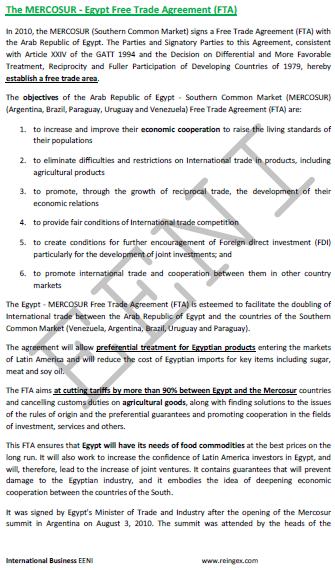
The objectives of the Egypt-MERCOSUR (Argentina, Brazil, Paraguay, Uruguay) Free Trade Agreement are:
- To increase and improve their economic cooperation
- To raise the Standard of living of their populations
- To eliminate the difficulties and restrictions on the trade in goods, including the agricultural products
- To promote, through the reciprocal trade growth, their economic relations development
- To provide fair conditions for the international trade competition
- To create the conditions for the further encouragement of the foreign direct investment (FDI) particularly for the joint investments development; and
- To promote the international trade and cooperation between them
The Egypt-MERCOSUR Free Trade Agreement is esteemed to facilitate the doubling of the international trade between Egypt and the member countries of the MERCOSUR.
The agreement will allow a preferential treatment for the Egyptian products entering into the Latin American markets and will reduce the cost of the Egyptian imports for the major items including sugar, meat, and soy oil.
Summary of Egypt-MERCOSUR Free Trade Agreement.
Chapter I: General Dispositions:
- Initial dispositions
- Trade in Services and Products
- Foreign Direct Investment
Chapter II: definition of the concept of “originating products.”
- Criteria for originating products
- Proof of origin
- Certificates of origin (Control and verification)
Chapter III: Preferential Safeguards.
- Conditions for application of preferential safeguard measures
- Investigation and transparency procedures
Chapter IV: disputes settlement.
Chapter V: final dispositions.
- Annex: originating products in the MERCOSUR imported into Egypt
- Annex: certificate of origin of the MERCOSUR-Egypt Agreement
- Annex: code of conduct for arbitrators of arbitration tribunal
- Annex: rules of procedure
Foreign Trade MERCOSUR-Egypt.
- Top Latin American trade partners of Egypt are Brazil and Argentina
- Foreign Trade between Egypt and Brazil reached USD 374.29 million between January and April with the Egyptian exports at USD 23.64 million and the Egyptian imports at USD 350.65 million
The MERCOSUR belongs to the Latin American Economic Area and Egypt to the Islamic and African Civilization.
More information: Egypt (EENI African Business Portal).

(c) EENI Global Business School (1995-2024)
We do not use cookies
Top of this page