Euro-Mediterranean Partnership EUROMED


Euro-Mediterranean free trade zone (EUROMED) Jordan, Lebanon, Egypt
- Introduction to the Euro-Mediterranean Partnership (EUROMED) - European Neighborhood Policy (European Foreign Policy)
- Barcelona Process. Union for the Mediterranean
- Trade Relations between the EU and the Southern Mediterranean countries
- Euro-Mediterranean Free Trade Zone
- System of pan-Euro-Mediterranean accumulation of origin
- Agadir Agreement
- Partnership agreements with Egypt and Jordan
The objectives of the subject “Euro-Mediterranean Partnership (EUROMED) of the EU” are the following:
- To know the basics of the Euro-Mediterranean Partnership
- To analyze the trade relations and association agreements that the EU has with the Southern Mediterranean countries

The Subject “Euro-Mediterranean Partnership (EUROMED)” belongs to the following Online Programs taught by EENI Global Business School:
Masters: International Business, Foreign Trade, Business in Africa.

Doctorate in African Business, Islamic Business, European Business, World Trade.

Courses: International Relations of Africa.
Languages:  or
or  Asociación Euromediterránea EUROMED
  EUROMED.
Masters for the Students from the
 EU,
EU,
 Albania,
 Bosnia,
 Egypt,
 Jordan,
 Lebanon,
 Montenegro,
 Syria and
  Turkey.
Euro-Mediterranean Partnership (EUROMED) European Union
The objective of the Union for the Mediterranean (Barcelona Process) is the economic integration development and democratic reform across sixteen neighbors of the EU in North Africa and the Middle East.
The members of the Union for the Mediterranean are the twenty-eight European Union member economies, Albania, Algeria, Bosnia and Herzegovina, Egypt, Israel, Jordan, Lebanon, Mauritania, Monaco, Montenegro, Morocco, Palestine, Syria, Tunisia, and Turkey.
As we can see, all the countries, except Montenegro and Israel, has Muslim majorities.
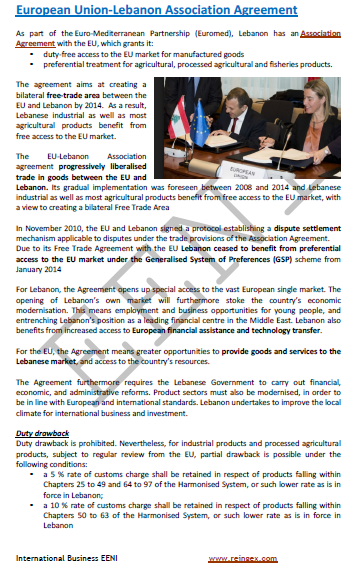
The main objective of the partnership agreement is the creation of a deep Euro-Mediterranean Free-Trade Area, which aims at substantially liberalizing the bilateral trade between both the EU and the Southern Mediterranean countries; and with the Southern Mediterranean countries themselves.
International trade in goods:
- European Union exports to the Southern Mediterranean region: Euros 119 billion
- The EU imports from the Southern Mediterranean region: Euros 105 billion
- The EU total foreign trade with the Southern Mediterranean countries was Euros 224 billion - some 10% of the total of the EU international trade
The EU encourages the strengthening of the trade relations between the Southern Mediterranean countries:
- The Agadir Agreement between Tunisia, Morocco, Jordan, and Egypt (in force since 2007) remains open to other Arab Mediterranean countries
- Israel and Jordan have signed a Agreement
- Egypt, Israel, Morocco, Palestine, Syria, and Tunisia have signed bilateral Trade Agreements with Turkey
The Euro-Mediterranean Partnership (EUROMED) belongs to:
- Islamic Civilization
- European Economic Area (Europe) of the Western Civilization
(c) EENI Global Business School (1995-2024)
We do not use cookies
Top of this page