
Black Sea Synergy (European Union, Moldova)


EU Black Sea Synergy. Association Agreements with Moldova and Ukrain
- Introduction to the Black Sea Synergy (European Union Foreign Policy)
- European Union's relationships with Ukraine and Moldova
- EU-Moldova Agreement
- Ukraine-EU Agreement
The objectives of the subject “Black Sea Synergy” are the following:
- To know the Black Sea Synergy program of the EU
- To explore the trade relations and the partnership agreements that the EU has with Moldova and Ukraine

The Subject “European Union Black Sea Synergy” belongs to the following Online Programs taught by EENI Global Business School:
Doctorate: European Business, World Trade.

Masters: International Business, Foreign Trade.
Masters adapted for  EU Students.
Doctorate and Masters in International Business adapted to the Students from the Black Sea Synergy:
 Armenia,
 Azerbaijan,
 Georgia,
 Moldova,
 Russia,
 Turkey, and
 Ukraine.
Languages:  or
or  Sinergia del Mar Negro
  Synergie de la mer Noire
 UE.
UE.

Black Sea Synergy (EU).
The EU encourages the development and regional cooperation in the South-east Europe region through the Black Sea Synergy
- The Black Sea countries are Armenia, Azerbaijan, Georgia (South Caucasus), Moldova, Turkey, and Ukraine
- Recently has seen the fast international trade development relations between the EU and the Organization of the Black Sea Economic Cooperation
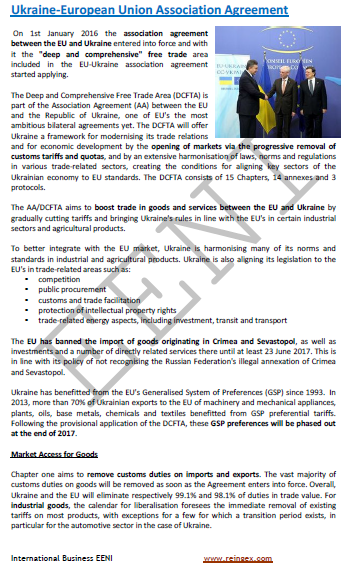
- Ukraine is a preference partner (European Neighborhood Policy)
- The Partnership and Cooperation Agreement (1998) is a framework for the bilateral cooperation between the EU and Ukraine
- Negotiations on a deep and exhaustive Free-Trade Area could be started
Foreign Trade EU-Ukraine:
- The EU is one of the largest trade partners of Ukraine (33% of the foreign trade)
- Ukraine was the 17th largest trading partner of the EU and the fifteenth largest export market
- The EU is the largest trading partner of Ukraine (27% of the total exports and 34% of imports)
Moldova is a partner nation within the European Neighborhood Policy.
- The EU and Moldova intend to set up a Deep and Exhaustive Free-Trade Area
Bilateral trade in products (European Union-Moldova).
- European Union exported products to Moldova: Euros 1.1 billion
- European Union imported goods from Moldova: Euros 523 million
The Black Sea Synergy is an inter-civilizational programme (Islamic, European, Orthodox Civilization).
(c) EENI Global Business School (1995-2024)
We do not use cookies
Top of this page