
European Free Trade Association


Economic Profile of the EFTA States (Norway Switzerland Iceland Liechtenstein)
- Introduction to the EFTA
- Economic Profile of the EFTA States: Iceland, Liechtenstein, Norway, and Switzerland
- European Economic Area
- Free Trade and Economic Integration Agreement of the European Free Trade Association (EFTA)
- Free movement of products and services
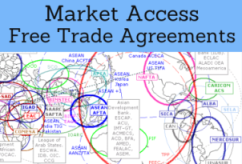
EFTA Trade Agreements:
- Asia: Singapore, India, South Korea, the Philippines, Hong Kong
- America: Canada, Colombia, Chile, Mexico, Peru, Central America
- Europe: Albania, Bosnia and Herzegovina, Georgia, Macedonia, Montenegro, Serbia, Turkey, Ukraine
- Africa: Egypt, Morocco, Tunisia, Southern African Customs Union (SACU)
- Middle East: Gulf Cooperation Council (GCC), Jordan, Lebanon, Israel, Palestine
The objectives of the subject “European Free Trade Association (EFTA)” are the following:
- To understand the objectives and functioning of the EFTA
- To evaluate the benefits for the EFTA States: free movement of goods and services
- To know the EFTA Trade Agreements
- To understand the “European Economic Area (EEA)” concept

The Subject “European Free Trade Association (EFTA)” belongs to the following Online Programs taught by EENI Global Business School:
Doctorate: European Business, World Trade.

Masters: International Business, Foreign Trade.
Languages:  or
or  Asociación Europea de Libre Comercio
  AELE
AELE  Associação Europeia de Livre Comércio (AELC).

European Free Trade Association (EFTA).
The EFTA is a regional economic organization created for promoting the free trade and economic integration. The member economies are Iceland, Liechtenstein, Norway, and Switzerland.
The EFTA Countries (Iceland, Liechtenstein, Norway, and Switzerland) are small but world leaders in several sectors.
- Liechtenstein and Switzerland are strong financial centers and have significant global companies
- Iceland and Norway are leaders in fish production, metal industry, and maritime transport
The European Economic Area consists of the EU member economies and the three European Economic Area - EFTA States (Iceland, Liechtenstein, and Norway) into an internal market lead by the same rules and regulations, with the objective to enable international trade in goods and services, capitals, and people to move freely in the European Economic Area.
A substantial part of the European Economic Area Agreement concerns the free movement of products. The main principle is that the export products may be traded between all the thirty Member States without customs duties or Barriers from the national regulations.
The European Economic Area Agreement grants the freedom to provide services anywhere in the European Economic Area.
The EFTA belongs to the European Economic Area of the Western Civilization.
The EFTA network of Free Trade Agreements secures to the economic operators a preferential access to the international markets:
- Albania
- Canada
- Chile
- Colombia
- Egypt
- Cooperation Council for the Arab States of the Gulf
- Israel
- Jordan
- South Korea
- Lebanon
- Macedonia
- Mexico
- Morocco
- Palestine
- Peru
- Serbia
- Singapore
- Southern African Customs Union
- Tunisia
- Turkey
- Ukraine
Sample: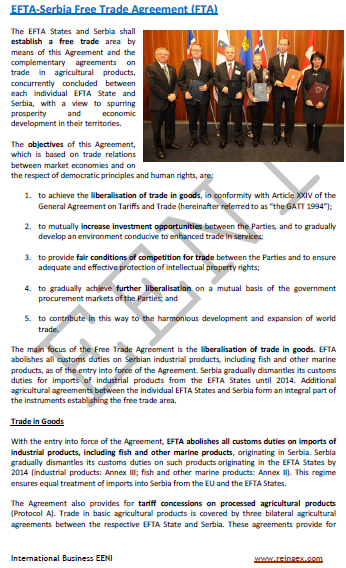
Trade Agreements (negotiations):
- Algeria
- Bosnia and Herzegovina
- Hong Kong (China)
- India
- Indonesia
- Montenegro
- Russia, Belarus, and Kazakhstan
- Thailand
The European Free Trade Association has Joint Declarations on Cooperation with the following partners:
- Malaysia
- Mauritius
- MERCOSUR
- Mongolia
- Montenegro
- Panama
Switzerland has signed bilateral Trade Agreements with the EU.
Sample: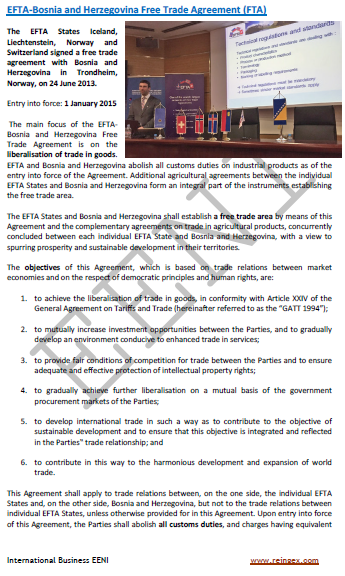
(c) EENI Global Business School (1995-2024)
We do not use cookies
Top of this page