EENI
Business School

Certificate program economy and integration in Latin America e-learning

EENI Home EENI International Business - America - Foreign Trade Courses

International business

Master International Business


Specialization course "Certificate program Economy and integration in Latin America" - Syllabus:


Latin America: Economy and foreign trade

- Latin America economy.
- Effects of global crisis in Latin America and the Caribbean.
- Key challenges: innovation and technological change.
- Foreign trade of Latin American countries: exports and imports.
- Economic relations with China.
- The growing influence of China and other emerging economies.
- Regional integration in Latin America and the Caribbean.

Inter-American Development Bank (IDB)

- The Inter-American Development Bank (IADB).
- Operational chart. Member countries.
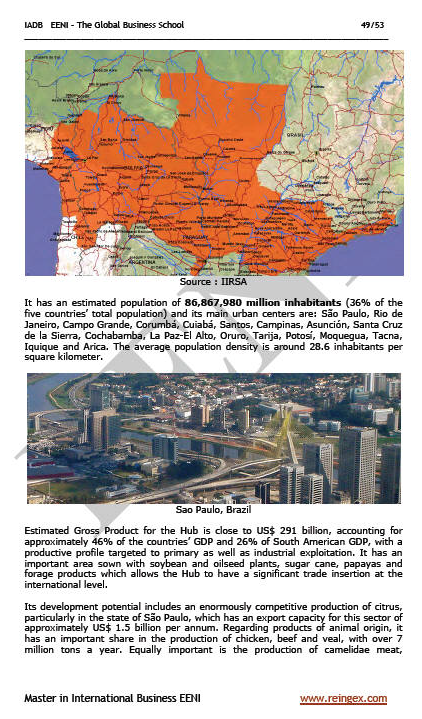
- Integration of regional infrastructure in South America (IIRSA).
- Case study : integration and development hubs in Latin America.
- Inter-American Investment Corporation (IIC).
- Multilateral Investment Fund (MIF).
- IDB project cycle: preparation, approval, implementation, completion and evaluation.

Economic Commission for Latin America (ECLAC)

- The Economic Commission for Latin America and the Caribbean (ECLAC CEPAL).
- Objectives. Member countries. History.
- Economic reports of ECLAC, Statistical yearbook, CEPALSTAT, ...

Latin American Integration Association (ALADI)

- The Latin American Integration Association (ALADI).
- Montevideo Treaty 1980 (TM80). Institutional organization.
- Agreement on Reciprocal Payments and Credits. Payment System in local currencies SML.
- Economic profile of ALADI countries.
- Customs procedures in ALADI countries.
- Nomenclature of the Latin American Integration Association (NALADISA)
- The Latin American Free trade association (LAFTA)

Organization of American States (OEA)

- The Organization of American States OEA.
- Foreign trade information system SICE.
- Trade agreements in America.
- Summit of the Americas.
- Free trade area of the Americas (FTAA ALCA).

Union of South American Nations (UNASUR)

- Union of South American Nations (UNASUR).
- Member countries. Organs.
- Objectives of the UNASUR.
- The integration of South America.

Latin American and Caribbean economic System (SELA)

- The Latin American and Caribbean economic System (SELA).
- Latin American Council.
- Digital information and knowledge center.

Bolivarian Alternative for the Americas (ALBA)

- Bolivarian Alternative for the Americas ALBA.
- TCP: the Trade Treaty of the Peoples.
- "Grannacionales" projects. PetroCaribe.
- Bank of ALBA. Regional Clearing Unit System of Payments (SUCRE).

Mesoamerica project

- Mesoamerica project.
- Background: ex Plan Puebla Panama.
- Meso-American countries.
- Transport. Telecommunications.
- Case study: International Network of Mesoamerican Highways (RICAM) and the Pacific corridor.

Summit of South American Arab Countries (ASPA)

- Summit of South American-Arab Countries.
- UNASUR and the League of Arab States.
- III Summit of Heads of State.
- The Brasilia and Doha Declarations.

Forum for East Asia-Latin America Cooperation (FEALAC)

- Introduction to the Forum for East Asia-Latin America Cooperation (FEALAC).
- Objectives and organization.
- Introduction to Latin America-Asian Economic Relations.
- Manila Plan of Action.

Southern Common Market (MERCOSUR)

- MERCOSUR Southern Common market. Treaty of Asuncion. The Administrative Secretariat.
- The new institutional phase.
- The MERCOSUR political, economic and commercial.
- The Common external tariff EAC.
- MERCOSUR Origin Regime ROM.

Andean Community (CAN)

- The Andean Community (CAN).
- The Andean integration system (SAI).
- Economic profile of the Andean countries.
- The Andean Community's common foreign policy (CFP). Relationships with Mercosur, USA, China, India, Russia, ...
- Trade Agreement between Colombia, Peru and the European Union.
- CAN: Productive and commercial development. Trade in goods, services and investments. Transportation.
- The Andean customs union. Free trade area. Common market. The NANDINA nomenclature. Common external tariff (ARIAN).
- The Andean Development Corporation (CAF).

North American Free Trade Agreement (NAFTA)

- The North American Free trade agreement (NAFTA).
- NAFTA institutions. Free Trade Commission. NAFTA background.
- NAFTA rules of origin.
- Economic facts about NAFTA.
- Success Stories.

Central American Integration System (SICA)

- The Central American Integration System (SICA).
- Functions and objectives. Member countries. Specialized agencies.
- Secretariat for Central American economic integration (SIECA).
- Central trading scheme: Origins of the goods, safeguard measures, Central American Tariff System (SAC).
- Central America Free trade area. Customs and monetary union.
- Central American Bank for economic integration (BCIE).
- Free trade agreements. Association agreement EU-CA.

Caribbean Community (CARICOM)

- The Caribbean Community CARICOM.
- Economic profile of the Caribbean countries.
- Organisation of Eastern Caribbean States (OECS).
- The CARICOM Single Market and Economy (CSME).
- Trade Policy of the Caribbean Community. Caribbean Development Bank (CDB). Eastern Caribbean Central Bank (ECCB).
- CARIFORUM Economic Partnership Agreement (EPA European Union).
- CARICOM's trade relations. Trade Relationship with Canada. CARICOM - US (United States). Free Trade Agreement with Colombia

Association of Caribbean States (ACS)

- Association of Caribbean States ACS.
- Functions and organization.
- Member countries. Greater Caribbean.

Asia-Pacific Economic Cooperation (APEC) ©

- Introduction to Asia-Pacific Economic Cooperation (APEC) ©.
- Structure. Bogor Goals. Osaka Action Agenda.
- Trade and Investment Liberalisation. Business Facilitation. Economic and Technical Cooperation.
- Achievements and benefits.

Pacific Economic Cooperation Council (PECC)

- Introduction to the Pacific Economic Cooperation Council (PECC).
- Task forces. Trade and Investment in Services. Pacific Food System.
- State of the Region Report.
- Index of Economic Integration in the Asia-Pacific.
- PECC and the Free Trade Area of the Asia-Pacific (FTAAP).

TPP Trans-Pacific Strategic Economic Partnership Agreement

- Introduction to the TPP Trans-Pacific Strategic Economic Partnership Agreement.
- Free trade in goods. Rules of Origin.
- Trade in services.

M Request Information Certificate program Economy and integration in Latin America.

M Duration: 8 weeks

Course objectives: The main objective of the "Certificate program economy and integration in Latin America" is to provide an overview of the Latin America economy, institutions (Inter-American Development Bank, ECLAC, ALADI) and economic integration

Addressed to: the "Certificate program economy and integration in Latin America" is intended for all those wishing to specialize in the Latin America economy and economic integration.

M Course tutors:
Turk HenryAudician

M Course learning materials: En
Also available in: Es Diplomado en Economía e Integracion de América Latina Fr Pt

Communication with tutors (student's questions, exercises ...) in: Es En Fr Pt

Methodology:
e-learning / Distance learning.

M Educational level: Continuing education / Executive education programs.

M Related courses and masters: Master Business in the Americas - Master in business in Latin America. Spanish: Curso Integración América Latina

Course summary (Economy and integration in Latin America):

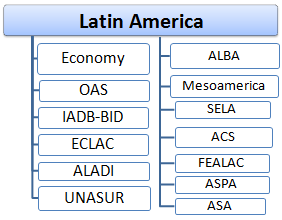
Course Distance learning: Economy, integration and institutions in Latin America: BID, CEPAL, ALADI, UNASUR, Mercosur, CAN, TLCAN, SICA, AEC, CARICOM

After six years of uninterrupted growth, the GDP of Latin America and the Caribbean is expected to fall by 1.8% and per capita GDP by close to 2.9% in 2009. The global crisis hit the region hard at the end of 2008 and in early 2009, taking a toll on all of its countries. However, a recovery began to take shape in the second quarter and became more widespread in the second half of the year. Growth is projected at 4.1% for 2010 and is expected to be somewhat higher in the countries of South America than in the rest of the region, given their larger domestic markets in some cases, greater export-market diversification and closer trade ties with China.

Foreign direct investment (FDI) flows to Latin America and the Caribbean will rebound in 2010, rising 40% to 50%, after dropping in 2009 as a result of the global crisis, according to ECLAC's annual report on FDI. Brazil continued to be the main recipient of FDI, followed by Chile, México, Colombia and Argentina. As in the past, the services sector received the most amount of FDI in 2009, while the primary sector (agriculture, mining and hydrocarbons) experienced a relative drop. The United States continued to be the main investor in the region, followed by Spain and Canada.

The Inter-American Development Bank IDB was founded in 1959 as a partnership between 19 Latin American countries and the United States. Today the IDB is owned by 48 member states, of which 26 are borrowing members in Latin America and the Caribbean. The IDB Group is composed of the IDB, the Inter-American Investment Corporation (IIC) and the Multilateral Investment Fund (MIF). The IIC focuses on support for small and medium-sized Business, while the MIF promotes private sector growth through grants and investments.

Example of the course Economy and integration in Latin America:
Inter-American Development Bank IDB

Economic Commission for Latin America and the Caribbean ECLAC was established by Economic and Social Council resolution 106(VI) of 25 February 1948 and began to function that same year. It was founded for the purposes of contributing to the economic development of Latin America, coordinating actions directed towards this end, and reinforcing Economic relationships among the countries and with the other nations of the world.

The ALADI (Latin American Integration Association) is the largest Latin-American Group of integration. The ALADI promotes the creation of an area of economic preferences in the region, aiming at a Latin-American Common market.

ALADI Latin American Integration Association

The Organization of American States (OAS) is the world’s oldest regional organization. Today it comprises the 35 independent states of the Americas and has granted permanent observer status to 63 states, as well as to the European Union. The Organization of American States constitutes the principal political, juridical, and social governmental forum in the Hemisphere.

The Third Summit of South American Presidents (Cusco 2004) witnessed the political creation of the South American Community of Nations UNASUR, a great political project combined with a program of decentralized development. As decided by the Presidents at that meeting, the South American Community of Nations will be shaped through the gradual convergence of the Andean Community and MERCOSUR and Chile, together with Guyana and Suriname. UNASUR has a GDP of 973 billion 613 million dollars, making it the world's fifth-ranking power.

Union of South American Nations UNASUR

The Latin American and Caribbean economic System (SELA) is a regional intergovernmental organization that Groups 26 Latin American and Caribbean countries. Its headquarters are in Caracas, Venezuela. The main objectives of SELA are to provide the Latin American and Caribbean region with a system of consultation and coordination for the adoption of common positions and strategies on economic issues in international bodies and forums and before third countries and Groups of countries and foster cooperation and integration among the countries of Latin America and the Caribbean.

The ALBA (Bolivarian Alternative for the Americas), is a proposed alternative to the U.S.-sponsored Free trade area of the Americas (FTAA, ALCA in its Spanish initials), differing from the latter in that it advocates a socially-oriented trade block rather than one strictly based on the logic of deregulated profit maximization. ALBA represent a population of 74 million people.

The Mercosur (Southern Common Market) is the fourth largest economic group in the world with a GDP of 1.989 billion U.S. dollars and a population of 242 million in 2008. Brazil is the largest economy with 79% of Mercosur's GDP, followed by Argentina with 18% to 2% for Uruguay and Paraguay with 1%. The Mercosur was created by Argentina, Brazil, Paraguay and Uruguay in March 1991 with the signing of the Treaty of Asuncion.

MERCOSUR Southern Common Market

The Andean Community (COMUNIDAD ANDINA)Is a subregional organization endowed with an international legal status, which is made up of Bolivia, Colombia, Ecuador y Peru and the bodies and institutions comprising the Andean Integration System (AIS).

In January 1994, Mexico joined Canada and the United States in the North American Free Trade Agreement (NAFTA), which will phase out all tariffs over a 15-year period. Under NAFTA, merchandise trade between the U.S., Canada and Mexico has tripled, reaching US$946.1 billion in 2008.

The Central American Integration System (SICA) is the institutional framework of regional integration in Central America, created by the states of Belize, Costa Rica, El Salvador, Guatemala, Honduras, Nicaragua and Panama.

Markets analyzed in the Master Business in Latin America:
Master Business in Latin America

Certificate, Program, Economy, integration, Latin America, e-learning, Course, distance, learning, institutions, Latin, America, BID, CEPAL, ALADI, UNASUR, Mercosur, CAN, TLCAN, SICA, AEC, CARICOM


UN (c) EENI- The Global Business School (1995-2011)
EENI Headquarters: Spain. Subsidiaries: France and Brazil.
EENI is full member of the International Commission on Distance Learning (ECOSOC United Nations).

Collaborator member of the Tripartite Foundation for On-the-job Training - European Social Fund (ESF).
European