EENI
Business School

Certificate program African economy integration in Sub-Saharan Africa

EENI Home EENI International Business - Africa - Foreign Trade Courses

International business

Master International Business


Certificate program in African economy and economic integration in Sub-Saharan Africa - Syllabus:


African economy and foreign trade

- Introduction to Africa (socioeconomic, population, religion, languages, ...)
- Introduction to African economy. Economic development report.
- Africa in the global economy. African foreign trade.
- Africa and the global financial crisis.
- Africa and the United Nations. Millennium Development Goals.
- Africa and the World Bank.
- Regional trade agreements in Africa.

African Development Bank

- Introduction to the African Development Bank (AFDB).
- African Development Fund (ADF). Nigeria trust fund (NTF).
- Regional integration in Africa.
- African peer review mechanism. African women in business initiative.
- The Investment climate facility (ICF).
- Transport in Africa. CEMAC trade corridor project.
- Africa and the global crisis. Africa food crisis response.
- Multilateral debt relief initiative (MDRI).
- Financial instruments. Lending and non-lending instruments.
- Doing business with the African Development Bank. Procurement.
- Projects and operations. Project cycle.

United Nations Economic Commission for Africa UNECA

- Introduction to the United Nations Economic Commission for Africa (ECA).
- ECA member states. African Development Forum (ADF).
- Trade, finance and economic development division.
- Economic report on Africa (ERA).
- Procurement Unit: Doing business with UNECA.

African Union AU

- Introduction to the African Union.
- Objectives and members.
- Regional economic communities: CEN-SAD, ECCAS, COMESA, ECOWAS, IGAD, SADC, UMA.

New Partnership for Africa’s Development NEPAD

- Introduction to the NEPAD (New Partnership for Africa's Development).
- NEPAD Secretariat. Socio-economic development.
- The African Peer review mechanism (APRM).
- African Regional economic communities (RECs).

Africa’s regional integration

- Africa: regional economic communities REC.
- The report on assessing regional integration in Africa (ARIA).
- Trade and market integration.
- Trends in intra-African trade.
- Physical integration: transport, information and communications technologies (ICTs).
- Monetary integration in Africa.

Arab Maghreb Union

- The Maghreb. History. Population. Geography. Trans-Maghreb.
- The Maghreb economy. Foreign trade: exports and imports.
- Competitiveness in Arab Maghreb Union (AMU) countries (Algeria, Libya, Morocco, Mauritania and Tunisia).
- Introduction to the Arab Maghreb Union. Marrakech Treaty. Objectives and missions.
- AMU institutions. agreements with similar organizations.

Economic Community of West African States ECOWAS

- Introduction to the Economic Community of West African States (ECOWAS). Project VISION 2020.
- Socio-economic development of the ECOWAS region. Ecobiz.
- West African Monetary Institute (WAMI).
- ECOBANK.
- The West African Development Bank (WADB).
- ECOWAS Bank for Investment and Development (EBID - BIDC).
- Case study: ASKY Airline. The West African Power Pool (WAPP).

West African Economic and Monetary Union UEMOA

- Introduction to the West African economic and Monetary Union (UEMOA).
- Achievements of the UEMOA.
- The economies of UEMOA member states.
- The Central Bank of West African States (BCEAO).
- History of the CFA franc.
- West African Development Bank (BOAD).
- Financial crisis, trade and regional integration in West Africa.
- Economic and financial situation of the Union.

Intergovernmental Authority on Development IGAD

- Introduction to the Intergovernmental Authority on Development (IGAD).
- The IGAD region: Djibouti, Eritrea, Ethiopia, Kenya, Somalia, Sudan and Uganda.
- Regional processes and alliances. IGAD Partners Forum (IPF).
- Economic Cooperation and Social Development. Economy, Foreign trade, industry, tourism, transport, Information and communication technology (ICT).

East African Community EAC

- Introduction to the East African Community EAC.
- Customs, market and economic union. Organs of the community. Economy and foreign trade.
- EAC Developing strategic partnerships.
- East African Development Bank (EADB).

Common Market for Eastern and Southern Africa COMESA

- Introduction to the Common market for Eastern and Southern Africa (COMESA).
- COMESA FTA Free trade area. Customs Union. Regional economy.
- The Eastern and Southern African Trade and Development Bank (PTA Bank).
- The infrastructures in COMESA region.
- Case study: Investing in textile, Oil seeds and leather sector.

Arab Mediterranean Free trade agreement - Agadir Agreement

- Introduction to the Arab Mediterranean Free trade agreement (Agadir Agreement).
- Members: Egypt, Morocco, Tunisia and Jordan.
- The Agadir Technical Unit. The Barcelona process.
- The Agadir Agreement and the Pan-Euro-Mediterranean system of cumulation of origin.
- Regional trade in Agadir countries. Trade with the European Union.
- Case study: Doing business in Jordan.
- Case study: automotive sector in the Arab-Mediterranean free trade agreement.

IORARC

- Ocean Rim Association for Regional Cooperation (IORARC).
- Member countries. Objectives.
- Indian Ocean Rim Business Centre (IORBC).

Community of Sahel-Saharan States (CEN-SAD)

- Introduction to the Community of Sahel-Saharan States CEN-SAD.
- Sahel-Saharan Investment and Trade Bank.
- Regional food security program (RFSP/CEN-SAD).
- Great Green wall program. Fight against desertification.

Economic Community of Central African States (ECCAS)

- Introduction to the Economic Community of Central African States ECCAS.
- Structure of ECCAS. Mission. Areas of intervention of ECCAS.

Africa China economic relationships

- Introduction to the Forum on China-Africa Co-operation.
- China's African policy.
- FOCAC Summit Beijing and Sharm el-Sheikh.
- Sino-African foreign trade relations.

Africa India economic relationships

- Economic relationships between Africa and India.
- Africa - India framework for cooperation.
- Africa - India Forum Summit.
- Delhi declaration.

Cotonou Agreement Africa European Union

- The Africa - European Union strategic partnership.
- EU infrastructure trust fund for Africa.
- The Cotonou Agreement. The ACP group.
- Euro-Mediterranean partnership.
- European neighbourhood policy.
- EU bilateral relations with Africa. Trade development and cooperation agreement (TDCA) with South Africa. The EU-Algeria association agreement.
- Agreements with Egypt, Morocco and Tunisia.

AGOA - African Growth and Opportunity Act. U.S. Africa trade

- Introduction to the African Growth and Opportunity Act (AGOA). AGOA IV.
- Country, product and apparel eligibility.
- United States - Africa trade. Leading U.S. export markets in Sub-Saharan Africa.
- Sub-Saharan African suppliers to the United States.
- U.S. Foreign Direct Investment in Africa. Successes cases.
- African global competitiveness initiative (AGCI). Africa trade hubs.
- Case study: Handcrafts export growth in Ghana. Senegalese exporters. African Growers in Atlanta.
- Summaries in Spanish and French.

Africa - South America Summit (ASA)

- Africa - South America Summit (ASA).
- Union of South American Nations (UNASUR) and the African Union.
- Declaration of Abuja and New Sparta. Marrakech plan of action.

Africa: Infrastructures and telecommunications

- Economic growth and infrastructures in Africa.
- The Africa infrastructure country diagnostic.
- Logistics and transport sector in Africa.
- Information and communication technologies.

M Request Information Certificate program in African economy integration.

M Duration: 8 weeks

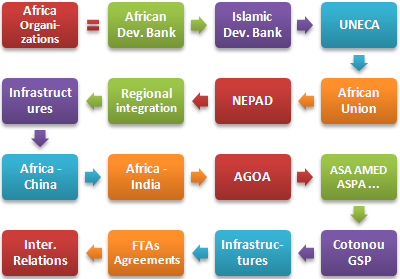
Course objectives: The main objective of the "Certificate program in African economy and Economic Integration in Sub-Saharan Africa" is to provide an overview of the African economy, Institutions (African Development Bank, UNECA, NEPAD), Economic integration and relationships with USA (AGOA), Europe (Cotonou), China and India.

Addressed to: the "Certificate program in African economy and Economic integration in Sub-Saharan Africa" is intended for all those wishing to specialize in the African economy and economic integration.

M Course tutors:
Turk Akogoun

M Course learning materials:
En
Fr L'économie Africaine
Pt Economia da africa

Communication with tutors (student's questions, exercises ...) in:
En Fr Pt Es

Methodology: e-learning / Distance learning.

M Related courses and masters: Master International Business for African Students - Master Executive Business Africa - Master Business West Africa Maghreb - Master East and Southern Africa - Master Muslims countries. Spanish: Curso Comercio Exterior

Course summary (African economy and economic integration):

Specialization course distance e-learning: ADB UNECA NEPAD AU. African foreign trade. Infrastructures. Relationships: Agoa, Cotonou, China, India.

- African economy and foreign trade.
- The African Development Bank
- Economic Commission for Africa UNECA.
- African Union AU.
- New Partnership for Africa's Development NEPAD.

- The Cotonou Agreement Africa European Union.
- AGOA African Growth and Opportunity Act. United States - Africa trade.
- Africa China: economic relationships.
- Africa India: economic relationships.
- Africa's regional integration.
- Infrastructures and telecommunications in Africa.

Growth in Africa, which had accelerated from 3.1 percent in 2000 to 6.1 percent in 2007, is now projected at only 1.7 percent for 2009 – down from the projected 6.4 percent, and far below the average growth rates of 5.3 percent posted by the continent’s best 15 performing countries for more than a decade. Following half a decade of above 5 per cent economic growth, the continent can expect only 2.8 per cent in 2009, less than half of the 5.7 per cent expected before the crisis. The creation of several institutions for economic integration in Africa in the last two decades was expected to boost intra-African trade in goods.

Analysis of trade destinations reveals that despite the low aggregate level of intra-African trade, such trade is very important for many African countries. At least 25 per cent of exports from 20 countries are absorbed by the regional market. Approximately 255 million people live in West Africa and 225 million in East Africa, the two most populous of Africa’s five regions, almost as many as in the entire U.S. Central Africa, the least populous, has over 100 million people. Southern Africa and North Africa each have about 150 million.

Example of the course (African economy and economic integration):
African economy foreign trade

The private sector has driven the expansion of information and communications technology in recent years. Oil producer Nigeria has been increasing its dominance, and in 2007 accounted for well over half of total investment in resource rich countries.

Africa’s current particularly defective transport network prevents countries from being competitive, especially on the world market. In Africa, roads represent the most important means of transport, carrying nearly 90% of passengers and freight. Half of the countries on the continent are landlocked and the transport cost might represent as high as 77% of the value of exports.

The proportion of Africans living on less than $1.25 a day fell from 58 percent in 1996 to 50 percent in the first quarter of 2009. Africa is the second largest continent in the world. 1000 languages are spoken in Africa (40 of which have more than one million speakers).

The AFDB (African Development Bank Group) is a multilateral development bank whose shareholders include 53 African countries (regional member countries RMCs) and 24 non-African countries from the Americas, Asia, and Europe (non-regional member countries non-RMCs). In line with the Medium-Term Bank Group strategy 2008-2012, the Bank continued to focus its operations on supporting infrastructure, private sector development, good governance, and regional integration.

AFDB African Development Bank

The Economic Commission for Africa (ECA) was established by the Economic and Social Council (ECOSOC) of the United Nations (UN) in 1958 as one of the UN's five regional commissions. ECA's mandate is to promote the economic and social development of its member states, foster intra-Regional integration, and promote international cooperation for Africa's development.

The African Union (AU) is Africa’s premier institution and principal organization for the promotion of accelerated socio-economic integration of the continent, which will lead to greater unity and solidarity between African countries and peoples. As a continental organization it focuses on the promotion of peace, security and stability on the continent as a prerequisite for the implementation of the development and integration agenda of the Union.

The NEPAD (New Partnership for Africa’s Development) strategic framework document arises from a mandate given to the five initiating Heads of State (Algeria, Egypt, Nigeria, Senegal, South Africa) by the Organization of African Unity (OAU) to develop an integrated socio-economic development framework for Africa. NEPAD is designed to address the current challenges facing the African continent.

Cotonou Agreement (Africa European Union). Europe and Africa are connected by strong trade links, making the European Union (EU) the biggest export market for African products. For example, approximately 85% of Africa’s exports of cotton, fruit and vegetables are imported by the EU. The EU-Africa summit, held in Lisbon, cemented new Africa-EU Strategic partnership, marking a qualitative leap in relations between the two continents. The Joint Africa-EU Strategy provides an overarching long-term framework for Africa- EU relations, while its first action plan specifies concrete proposals for 2008-2010, structured along 8 Africa-European Union (EU) Strategic partnerships.

Example of the course:
Africa Infrastructures Telecommunications

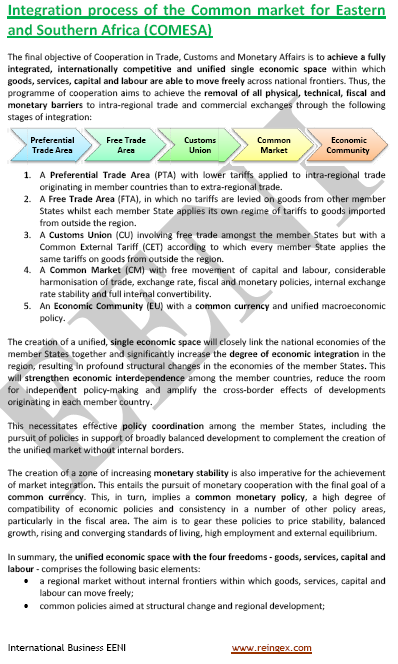
Africa’s regional integration . The ultimate goal of the UNECA is to create an African Common market. An area where RECs Regional economic communities have been observed to be most active is trade and market integration. These RECs include the Arab Maghreb Union (AMU), the Southern African development community (SADC), the Common Market for Eastern and Southern Africa (COMESA), the East African Community (EAC), the Inter-governmental Authority on Development (IGAD), the Economic Community of West African States (ECOWAS), the Central African Economic and Monetary Community (CEMAC), the Economic Community of Central African States (ECCAS), and the West African Economic and Monetary (UEMOA).

The cost of doing business in the continent is generally high, due in part to infrastructure gaps, duplicative border procedures and cumbersome paper requirements. Paperless trade still remains a distant objective. The free movement of people and the right of establishment have progressed in some RECs, but remain a paper objective in many other African subregions.

African exports remain heavily concentrated in a few primary commodities, in particular fuels and mining products. of the top 20 products exported by the region in the period 2000-2005, the great majority are fuels, fuel products and mineral products. A few are basic agricultural commodities (sugar, cotton, cocoa and coffee) and a very small number are manufactured products.

Infrastructure has been a major driver of strong economic growth in Africa in recent years. Better infrastructure could make an even greater contribution. Africa’s transport sector requires some $18 billion in annual investment, almost half for operations and maintenance.

A continuous appraisal of Africa’s integration performance is essential, in order to gain a deeper understanding of the strengths and weakness of the integration efforts, and to help shape the future through lessons learned. It is from this perspective that the African Union Commission and the Economic Commission for Africa publish the report on assessing Regional Integration in Africa, well known by its ARIA acronym.

Africa Regional integration

The African Growth and Opportunity Act (AGOA) is a United States Trade Act that significantly enhances U.S. market access for (currently) 39 Sub-Saharan African (SSA) countries. U.S. total exports to Africa rose 22 percent to $10.3 billion, with notable gains in agricultural goods, machinery, and transportation equipment. U.S. total imports (AGOA and non-AGOA) from Africa increased by 40 percent to $50.3 billion, largely due to an increase in oil imports.

The Forum on China-Africa Co-operation (FOCAC) is a platform established by China and African countries. The two-way trade between China and Africa reached US$12.389 billion in 2002,growing 7 times from the 1991 figure of US$1.44 billion. The import on the Chinese side accounted for US$5.427 billion and its export was US$6.962 billion.

Africa - India Forum Summit. The Heads of State and Government and Heads of Delegation of Africa, representing the Continent, the African Union and its institutions along with the Prime Minister of the Republic of India, recognizing the rich history of Africa-India relationship and noting with satisfaction the existing close, deep and multi-layered relations between the two sides and realizing the need to give a new dimension to this cooperation, have decided to adopt this Framework for Cooperation between Africa and India.

Africa Trade Agreements

Master Executive Business in Africa

Certificate, Program, African, Economy, integration, Sub-Saharan, Africa, Specialization, course, distance, e-learning, ADB, UNECA, NEPAD, AU, foreign trade, infrastructures, Relationships, Agoa, Cotonou, China, India


UN (c) EENI- The Global Business School (1995-2011)
EENI Headquarters: Spain. Subsidiaries: France and Brazil.
EENI is full member of the International Commission on Distance Learning (ECOSOC United Nations).

Collaborator member of the Tripartite Foundation for On-the-job Training - European Social Fund (ESF).
European