
Central America-Panama Free Trade Agreement


Free Trade Agreement between Costa Rica, El Salvador, Guatemala, Honduras, Nicaragua, and Panama
- Introduction to the Central America-Panama Free Trade Agreement
- Advantages of the Agreement Panama-Central America
- Certification and Rules of origin
- Foreign Trade between Central America and Panama
- Case Study: Foreign trade of Costa Rica and Nicaragua with Panama
- Bilateral Protocol to the Free Trade Agreement between Costa Rica and Panama

The Subject “Free Trade Agreement between Central America and Panama” belongs to the following Online Programs taught by EENI Global Business School:
Masters: International Business, Foreign Trade.


Languages: 
 Centro America Panama
  Amerique Centrale
  América Central.

Sample - Central America-Panama Free Trade Agreement (FTA)
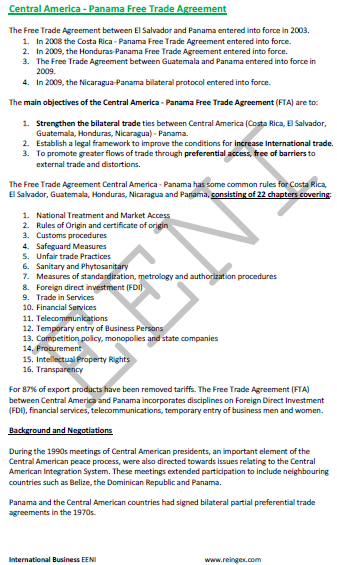
The main objectives of the Central America-Panama Free Trade Agreement are to:
- Strengthen the bilateral trade ties between Central America (Costa Rica, El Salvador, Guatemala, Honduras, and Nicaragua) and Panama
- Establish a legal framework to improve the conditions for increase the Foreign Trade
- To promote a greater trade flows through the preferential access, free of Technical Barriers to Trade (TBT) and distortions
The Free Trade Agreement between El Salvador and Panama entered into force in 2003.
- In 2008, the Costa Rica-Panama Free Trade Agreement entered into force
- In 2009, the Honduras-Panama Free Trade Agreement entered into force
- The Free Trade Agreement between Guatemala and Panama entered into force in 2009
- In 2009, the Nicaragua-Panama bilateral protocol entered into force
The Central America-Panama Free Trade Agreement has some common rules for Costa Rica, El Salvador, Guatemala, Honduras, Nicaragua, and Panama, consisting of twenty-two chapters covering:
- National Treatment and Market Access
- Rules of Origin and certificate of origin
- Customs Procedures
- Safeguard Measures
- Unfair Trade Practices
- Sanitary and Phytosanitary Measures
- Measures of standardization, metrology and authorization procedures
- FDI
- Trade in Services
- Financial Services
- Telecommunications
- Temporary entry for business persons
- Competition Policy, monopolies and state companies
- Procurement
- IPR
- Transparency
(c) EENI Global Business School (1995-2024)
We do not use cookies
Top of this page