
CARICOM Caribbean Community. Single Market


Caribbean Community (CARICOM Single Market and Economy). Bahamas, Barbados, Belize, Dominica...
- Introduction to the CARICOM
- Economic Profile of the Caribbean Countries
- Agreement on Free Trade and Economic Integration of the Caribbean Community and Common Market (CARICOM)
- CARICOM Single Market and Economy
- International Trade Policy of the Caribbean Community
- The Caribbean Development Bank
- CARIFORUM-EU Agreement
- Trade Relations with Canada and the U.S.
- Colombia-CARICOM Agreement
- CARICOM-Costa Rica Agreement
- CARICOM-Dominican Republic Agreement
- Caribbean-Canada Trade Agreement
- UK-CARIFORUM Free Trade and Economic Integration Agreement
- Caribbean Basin Initiative
- The U.S.-Caribbean Basin Trade Partnership Act (CBTPA)
- OECS
The objectives of the subject “Caribbean Community (CARICOM)” are the following:
- To understand the purposes and trade policy of the CARICOM
- To analyze the economic profile of the Caribbean Countries
- To evaluate the benefits for the CARICOM member countries
- To analyze the economic integration process (Caribbean Single Market and Economy) and the foreign trade among the Caribbean Community member countries
- To know the affiliated institutions:
- Caribbean Development Bank
- Organization of Eastern Caribbean States (OECS)
- To identify the CARICOM Trade Agreements

The Subject “Caribbean Community (CARICOM)” belongs to the following Online Programs taught by EENI Global Business School:
Masters: International Business, Foreign Trade.

Doctorate: American Business, World Trade.

Languages:  or
or  CARICOM
  CARICOM.
- Credits of the Subject “CARICOM”: 1

- Duration: one week
Masters adapted for Caribbean students.


Sample - Caribbean Community and Common Market (CARICOM):
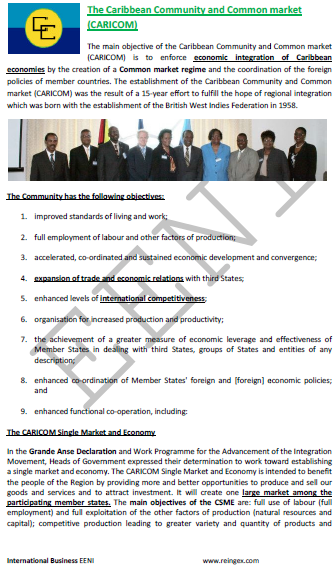
The main objective of the Caribbean Community and Common Market (CARICOM) is to enforce the economic integration of the Caribbean Economies (America) by the creation of a common market regime and the coordination of the foreign policies of the member countries.
The Caribbean Community and Common Market Member States are Antigua and Barbuda, The Bahamas, Barbados, Belize, Dominica, Grenada, Guyana, Haiti, Jamaica, Montserrat, Saint Lucia, Saint Kitts and Nevis, Saint Vincent and the Grenadines, Suriname, and Trinidad and Tobago.
- The associate members of the CARICOM are Anguilla, Bermuda, British Virgin Islands, Cayman Islands, Turks and Caicos Islands
- The observer states of the CARICOM are Aruba, Colombia, Curaçao, Mexico, Puerto Rico, Dominican Republic, Saint Martin and Venezuela
CARICOM Single Market and Economy.
- The CARICOM Single Market and Economy is planned to benefit the population of the Caribbean region by providing more opportunities to produce and trade products and services and to attract the foreign direct investment
- The CARICOM Single Market and Economy will create one single market among the participating member economies
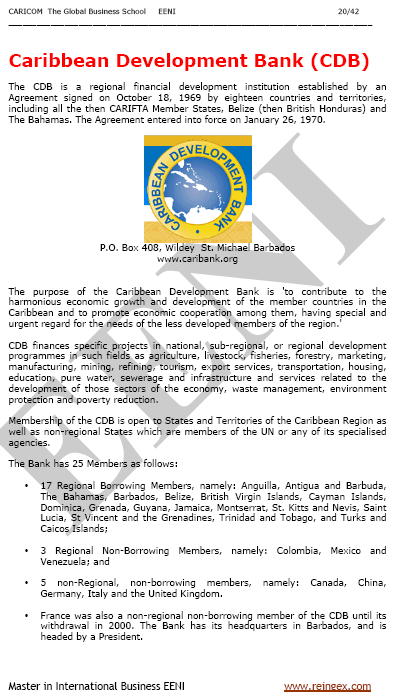
The Caribbean Development Bank is a regional financial development institution established in 1969 by an Agreement signed by eighteen countries and territories, including all the ten Caribbean Free Trade Association member economies, Belize (then British Honduras), and the Bahamas.
The Eastern Caribbean Central Bank is the Monetary Authority for the Eastern Caribbean Countries of Anguilla, Antigua and Barbuda, the Commonwealth of Dominica, Grenada, Montserrat, Saint Kitts and Nevis, Saint Lucia, and Saint Vincent and the Grenadines.
CARIFORUM Economic Partnership Agreement with the EU.
The Economic Partnership Agreement was signed on 2008 by the v: Antigua and Barbuda, Bahamas, Barbados, Belize, Dominica, Grenada, Jamaica, Saint Christopher and Nevis, Saint Lucia, Saint Vincent and the Grenadines, Suriname, Trinidad and Tobago, and Guyana.
Haiti signed on 2009.
The CARICOM belongs to the Western Civilization (Caribbean Economic Area).
(c) EENI Global Business School (1995-2024)
We do not use cookies
Top of this page