
Andean Trade Promotion Act (U.S. ATPDEA)


Andean Trade Promotion and Drug Eradication Act (The U.S. ATPDEA)
IMPORTANT NOTE: ATPDEA expired on July 2013, and has been replaced by the FTAs:
2- US-Peru FTA.
- Andean Trade Promotion and Drug Eradication Act (ATPDEA)
- U.S. foreign trade with Bolivia, Colombia, Ecuador, and Peru
The Subject “Andean Trade Promotion and Drug Eradication Act (ATPDEA)” belongs to the following Online Programs taught by EENI Global Business School:
Masters: International Business, Foreign Trade.

Doctorate: American Business, World Trade.



 Masters for the U.S. Students.
US-Andean Countries
United States- The Andean Trade Promotion and Drug Eradication Act (ATPDEA).
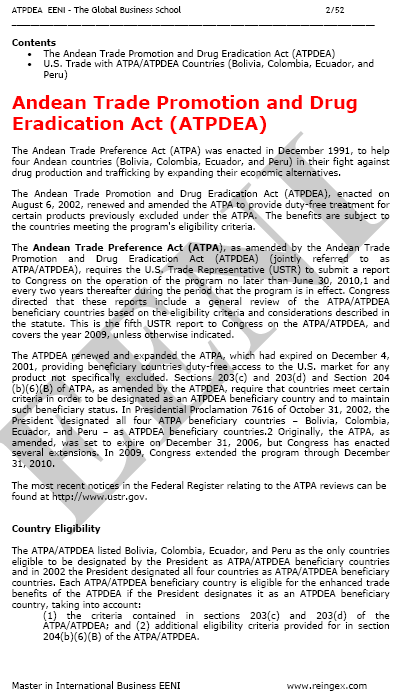
Andean Trade Preference Act (ATPA) was signed on 1991, to help the Andean Community countries (Bolivia, Colombia, Ecuador, and Peru) in their fight against drug production and trafficking by expanding their economic alternatives and improve the international trade.
Andean Trade Promotion and Drug Eradication Act (signed on 2002), renewed and amended the Andean Trade Preference Act to provide duty-free treatment for some export products previously excluded under the Andean Trade Preference Act.
United States trade with Bolivia, Colombia, Ecuador, and Peru fell substantially.
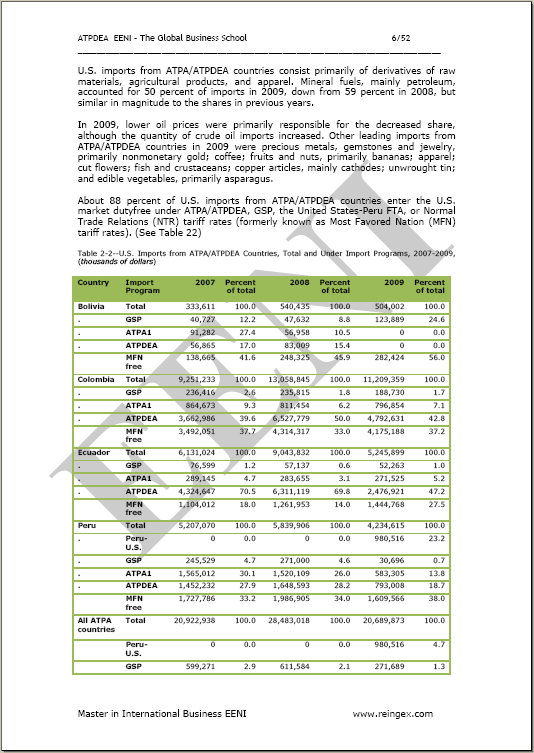
United States imports from the Andean Countries fell 26% to 21 billion dollars, and the U.S. exports fell 14% to 17.1 billion dollars, resulting in a trade deficit of 4 billion dollars. Over the past five years, the U.S. imports from the Andean region augmented 37% and the U.S. exports grew 123%.
The Republic of Colombia was the leading source of the U.S. imports under the Andean Trade Preference Act., having surpassed Ecuador The Republic of Colombia supplied 58% of the U.S. imports under Andean Trade Preference Act.; Ecuador, 28%; and Peru, 14%.
The Republic of Colombia was the largest export market for the U.S. exports at 8.8 billion dollars, representing 51% of the U.S. Exports to the Andean Countries.
Peru ranked second as a destination for United States exports, with 4.4 billion dollars in U.S. products (26%); Ecuador was third, with 3.6 billion dollars; and Bolivia was fourth, with 378 million dollars. The U.S. exports to Colombia and Peru fell 17% and 23%, respectively, but exports to Ecuador and Bolivia achieved 14% and 5%, respectively.
The Andean Trade Promotion and Drug Eradication Act (ATPDEA) was an Agreement inside the area of the Western Civilization (North American - Latin American).
(c) EENI Global Business School (1995-2024)
We do not use cookies
Top of this page